
Çentik vs PassKit: The Quick Answer
Choose Çentik if you operate a coffee shop, restaurant, bakery, bar, or retail business and want a ready-to-use loyalty experience centered on repeat visits. Its NFC and QR workflows support both count-based rewards and loyalty balances, with customer records, campaigns, and business analytics. Choose PassKit if your business needs to create and manage digital wallet passes across a wider range of use cases, including loyalty, membership, gift cards, coupons, and tickets. PassKit offers pass design, distribution, lifecycle management, automation, and developer APIs. Both support Apple Wallet and Google Wallet, but their approaches to customer engagement and implementation are different.[1][2]
Çentik vs PassKit: Feature Comparison
| Criterion | Çentik | PassKit |
|---|---|---|
| Primary purpose | Merchant-focused digital loyalty and customer retention | Digital wallet pass creation, management, and engagement infrastructure |
| Starting monthly price | $19.99/month for the first location | From $39.50/month for one team member, subject to pass-volume charges[2] |
| Customer app download | Not required; browser-based participation | Not required; customers can save wallet passes directly[1] |
| Apple Wallet and Google Wallet | Both supported | Both supported[1] |
| Count-based rewards | Supported through NFC or QR | Supported through configurable loyalty pass workflows[1] |
| Balance-based rewards | Supported through NFC or QR, including an optional POS-informed QR flow | Supports loyalty points and balances through wallet pass programs[1] |
| Physical NFC customer touchpoint | Dedicated Çentik Damper tap device | Wallet-centric platform; NFC implementations depend on the selected wallet and redemption setup[1][5] |
| QR interactions | Customer loyalty interactions and counter-displayed QR codes | Pass enrollment, distribution, scanning, and validation[1] |
| POS relationship | Core loyalty workflows can operate without replacing the existing POS; POS-informed QR workflows are optional | Can connect with POS, CRM, and other business systems through integrations and developer tooling[1] |
| Customer management | Merchant-facing customer records and repeat-visit tracking | Pass-holder enrollment, pass records, and lifecycle management[1] |
| Campaigns and engagement | Merchant loyalty campaigns and customer retention tools | Wallet messaging, updates, automation, and connected engagement workflows[1] |
| Analytics | Loyalty activity, customers, and repeat visits | Pass distribution, usage, lifecycle, and operational analytics[1] |
| QR menu | Available | Not a primary product use case |
| Memberships and event tickets | Not established as dedicated product capabilities | Supported pass categories[1] |
| Developer infrastructure | Merchant-facing product; public developer API scope not established | Documented APIs, SDKs, webhooks, automation, and developer workflows[1] |
| Pricing structure | Monthly Pro subscription for the first location | Monthly platform fee plus applicable multi-use and single-use pass-volume charges[2][3] |
| Best fit | Independent merchants and small chains prioritizing practical loyalty operations | Businesses and developers requiring flexible digital wallet infrastructure |
How Çentik Works: NFC, QR, and Two Reward Models
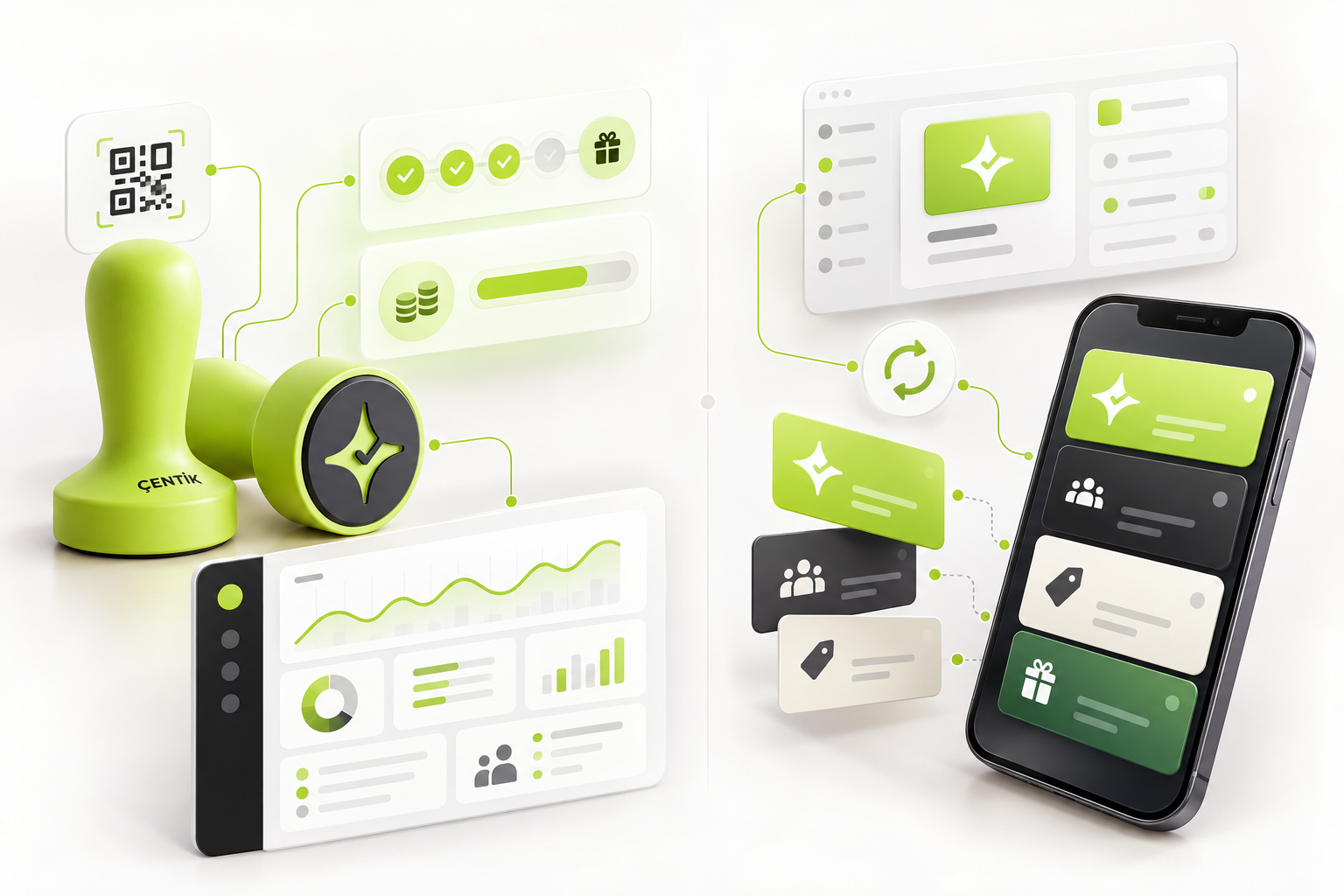
Çentik is designed around customer interactions at a physical business. A participating customer can use an NFC touchpoint or QR code to advance a loyalty program. Merchants can configure count-based rewards, such as earning progress toward a complimentary item, or use a balance-based loyalty model. Both reward types can be granted through NFC or QR interactions. The goal is to connect a simple customer action with a record of loyalty activity that the merchant can manage.
Count-Based Rewards
A count-based program rewards customers for accumulating qualifying visits or purchases. For example, a coffee shop could configure a reward after ten qualifying coffee purchases. Çentik supports this familiar loyalty format through its NFC and QR workflows. It is a useful model when the merchant wants customers to understand their progress without calculating points or reward balances.
Balance-Based Loyalty
Çentik also supports loyalty balances. Instead of awarding one count for every qualifying interaction, a merchant can grant a balance according to the configured loyalty program. A counter-facing POS interface can display a QR code that grants either a count or a balance. Where the optional POS-informed flow is configured, the balance granted through that QR interaction can reflect an amount received from the POS. This does not imply universal POS compatibility, automatic synchronization with every checkout system, or payment processing. Merchants should confirm the workflow supported by their specific POS environment.
The Physical NFC Experience
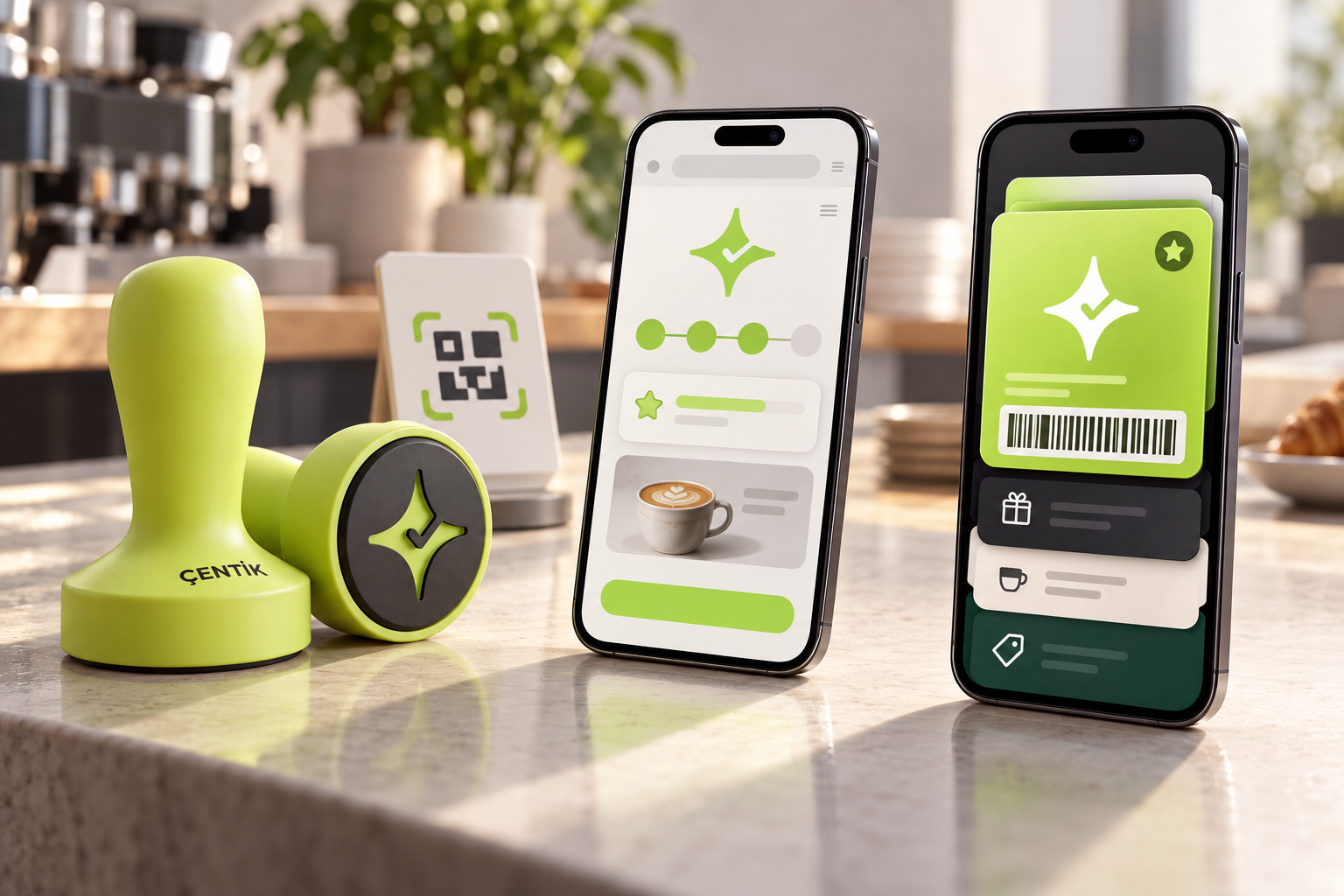
Çentik offers a physical NFC Damper that gives customers a recognizable tap point at the counter. This can make loyalty participation part of the everyday checkout routine. QR interactions provide an alternative when customers or merchants prefer scanning. The two interaction methods make it possible to design the experience around the business rather than forcing every merchant to use one customer-facing format.
How PassKit Works: Digital Wallet Infrastructure
PassKit approaches loyalty through digital passes rather than a dedicated physical merchant touchpoint. Its platform lets businesses create, distribute, update, validate, and analyze passes in Apple Wallet and Google Wallet. Loyalty cards are one application, alongside memberships, coupons, gift cards, event tickets, and other pass types. The platform includes a visual designer, enrollment pages, pass distribution tools, PassReader validation, analytics, automation, and developer interfaces. Businesses can start with templates and a management portal or build deeper integrations using APIs, SDKs, and webhooks.[1]
PassKit Is More Than a Digital Stamp Card
PassKit supports loyalty experiences involving points, balances, tiers, and offers. It also supports digital pass updates as customer details or program conditions change. That makes it relevant to businesses designing custom loyalty journeys, including programs connected to external CRM or commerce systems. The implementation may involve additional configuration or development depending on the desired experience. PassKit should not be characterized as stamp-only or as lacking balance-based loyalty.[1]
What About NFC and QR Codes?
PassKit supports QR-based pass distribution and scanning workflows. Its PassReader application can be used to validate passes, while its platform can connect wallet experiences with external systems. Apple Wallet itself also supports barcode and certain NFC-based pass interactions, subject to the relevant technical requirements. However, these capabilities are not equivalent to Çentik's dedicated NFC Damper experience. A merchant should evaluate the actual device, reader, and validation configuration rather than assuming that the two products use the same NFC workflow.[1][5]
Çentik vs PassKit Pricing in 2026
Çentik Pro costs $19.99 per month for the first location. PassKit's published self-serve rate card starts at $39.50 per month for one team member. The PassKit base fee includes up to 250 multi-use passes and 250 single-use passes, with separate volume-based charges above the included allowances. These are different pricing models, so businesses should compare the cost of their intended loyalty program rather than simply comparing subscription headlines.[2][3]
| Pricing Detail | Çentik | PassKit |
|---|---|---|
| Starting monthly charge | $19.99 for the first location | $39.50 for one team member[2] |
| Primary billing basis | Pro subscription | Team-member platform fee and applicable pass-volume charges[2] |
| Included pass allowance | No comparable pass-volume allowance specified | 250 multi-use and 250 single-use passes[2] |
| Two team members | Confirm applicable staff-account terms | $59.25/month platform fee before applicable additional pass charges[2] |
| Additional multi-use passes | No per-pass rate established | $0.0450 per pass in the 251–2,500 marginal tier[2] |
| Additional single-use passes | No per-pass rate established | $0.0945 per pass in the 251–2,500 marginal tier[2] |
| Billing considerations | Evaluate subscription scope and optional operational requirements | Evaluate team-member access, pass quantities, pass types, and deletion rules[2][3] |
PassKit's multi-use pass pricing matters particularly for ongoing loyalty and membership programs. Its published billing model counts applicable multi-use pass records according to the records created and deleted, while single-use passes are billed according to issuance during the month. This means a growing base of loyalty pass records can affect recurring costs even when customers do not use every pass frequently. PassKit also specifies lifecycle and expiry-related deletion rules that businesses should understand when forecasting costs.[2][3]
The pricing structures also reflect different product scopes. PassKit supplies infrastructure for numerous wallet use cases and provides developer tooling for custom implementations. Çentik is a more focused merchant loyalty product. Its lower listed starting subscription does not establish that every possible deployment will cost less, and PassKit's higher base fee does not make it unsuitable for smaller businesses. The relevant comparison is the total cost of implementing and operating the required customer experience.
Customer Experience: Tap or Scan vs Save to Wallet
Both platforms can provide loyalty participation without a separate customer app installation. With Çentik, the merchant can introduce customers to loyalty through an NFC touchpoint or a QR interaction at the counter. Customers can access their experience through the browser, with Apple Wallet and Google Wallet support also available. With PassKit, the digital wallet pass is the central customer-facing asset. Customers can receive a pass through supported distribution channels, save it to their wallet, and interact with it as the business updates the pass or validates it during a relevant transaction.[1]
- Choose Çentik's approach when a visible counter interaction is an important part of your loyalty program.
- Choose PassKit's approach when a branded Apple Wallet or Google Wallet pass needs to remain central throughout the customer relationship.
- Evaluate both if customers need app-free loyalty, QR participation, and wallet access.
- Test the actual redemption experience before making a decision, including staff actions, customer identification, and reward adjustments.
Merchant Operations vs Custom Wallet Programs
A practical distinction is how much of the loyalty operation the platform is intended to provide. Çentik combines reward participation with merchant-oriented customer records, campaigns, repeat-visit analytics, and QR menu functionality. This makes it relevant to businesses that want a loyalty product they can operate alongside their daily sales workflow. PassKit concentrates on the digital wallet infrastructure, including the design and lifecycle of pass records and connections to external services. These capabilities can support sophisticated engagement strategies, particularly where a business already has other systems responsible for customer data and transactions.[1]
Where Çentik May Be the Better Fit
- A neighborhood coffee shop wants a recognizable NFC loyalty touchpoint at checkout.
- A bakery wants customers to collect qualifying purchases toward a reward.
- A restaurant wants to offer a balance-based loyalty program using QR interactions.
- A bar or small retailer wants merchant-managed rewards without developing a custom wallet integration.
- A small business wants customer and repeat-visit insights within its loyalty product.
Where PassKit May Be the Better Fit
- A brand wants to distribute several different types of digital wallet passes.
- A membership organization needs wallet-based credentials and membership updates.
- A company wants to integrate wallet passes with an existing CRM, POS, or custom application.
- A developer team needs APIs, SDKs, webhooks, and automation for a custom customer journey.
- A business needs loyalty, coupons, gift cards, and ticketing within a broader digital wallet strategy.[1]
Integrations and POS Compatibility: What to Check
PassKit provides documented developer interfaces and integration capabilities, including APIs, SDKs, webhooks, and automation. It also describes connections to CRM, POS, and commerce systems. These tools can support custom workflows, but an available integration mechanism does not automatically establish that a specific merchant system is supported out of the box.[1] Çentik provides a loyalty workflow that can begin without a POS replacement, plus an optional counter-facing QR flow that can use an amount received from the POS to determine the loyalty balance granted. Merchants should verify the supported data flow for their specific POS software, the steps staff must perform, and what happens when transactions are canceled or corrected.
Limitations and Trade-Offs
Çentik Limitations
Çentik is centered on merchant loyalty rather than general-purpose wallet infrastructure. Organizations needing extensive custom pass development, event ticketing, membership credentials, or a developer-led distribution architecture may find PassKit more appropriate. Çentik's physical NFC experience may require merchants to introduce a new customer action at the counter. For POS-informed QR balances, implementation feasibility depends on the specific checkout environment. Businesses with complex enterprise integration requirements should establish the exact supported scope before selecting Çentik.
PassKit Limitations
PassKit's flexibility comes with implementation decisions. A business focused only on a simple in-store loyalty program may need to configure wallet templates, enrollment, validation, staff procedures, and connected systems to achieve its preferred experience. Its pricing also requires attention to platform access and the volume of pass records. While PassKit includes a management portal and no-code capabilities, custom loyalty logic or integrations may still require additional work. These are considerations rather than evidence that PassKit is difficult to use.[1][2][3]
Switching Between Çentik and PassKit
Moving from one loyalty platform to another requires more planning than replacing a digital card design. Customer identities, existing points, reward balances, earned counts, outstanding rewards, and pass ownership all need to be reconciled. Neither platform should be assumed to support a direct one-click migration from the other. Businesses should establish what information can be exported and imported, which customer permissions remain valid, and whether previously distributed wallet passes can be maintained or must be reissued.
- Inventory existing customers, loyalty identifiers, earned counts, reward balances, and unredeemed offers.
- Verify available export formats and whether required records can be imported into the destination system.
- Determine how existing Apple Wallet and Google Wallet passes will be handled, including issuer control and any re-enrollment requirements.
- Map old reward rules to the new program without silently changing customers' earned benefits.
- Test scanning, NFC interactions, staff approvals, balance changes, and reward redemption before rollout.
- Plan customer communications, privacy notices, and the transition period to minimize confusion.
- Confirm billing implications for any PassKit pass records that remain active during migration.[2][3]
Five Questions to Ask Before Choosing
- Is the primary goal to operate a repeat-visit loyalty program or to build a broader digital wallet experience?
- Do customers need a physical tap or scan interaction at checkout, or is a wallet-first journey more appropriate?
- Will rewards be count-based, balance-based, or part of a custom points and membership system?
- Which existing systems must exchange transaction, customer, or redemption information, and how will compatibility be demonstrated?
- What is the expected total cost after accounting for subscription fees, pass volumes, team access, implementation, and operational effort?
Final Verdict: Which Should U.S. Businesses Choose?
For an independent coffee shop, restaurant, bakery, or similar merchant that primarily wants repeat customers, Çentik is a practical option to evaluate first. It combines NFC and QR loyalty interactions with count-based rewards, balance-based programs, customer management, and repeat-visit insights at a listed $19.99 monthly starting price for the first location. For organizations whose strategy depends on customizable wallet passes, multiple pass categories, and developer-controlled integration workflows, PassKit is the more directly aligned platform. Its published pricing starts at $39.50 per month and scales with the relevant team-member and pass-volume requirements. Neither platform is universally better: the right choice follows the business's customer journey, operational needs, and implementation resources.[1][2]
Frequently Asked Questions
Is Çentik cheaper than PassKit?
Çentik Pro starts at $19.99 per month for the first location. PassKit's published self-serve platform fee starts at $39.50 per month for one team member, with applicable pass-volume charges beyond the included allowances. Çentik has the lower listed starting monthly subscription, but total costs depend on the deployment requirements.[2]
Does PassKit support loyalty points and balances?
Yes. PassKit describes support for loyalty points, balances, tiers, and offers through its digital wallet platform. These features may be configured as part of a broader wallet-based customer experience.[1]
Does Çentik support rewards based on spending?
Çentik supports a balance-based loyalty model in addition to count-based rewards. NFC or QR interactions can grant loyalty balances. An optional counter-facing QR workflow can also use an amount received from the POS to determine the balance granted, subject to the supported implementation.
Do customers need to install an app to use Çentik or PassKit?
A dedicated customer app is not required for the core experiences described here. Çentik supports browser-based participation, while PassKit enables passes to be saved directly to Apple Wallet or Google Wallet.[1]
Does PassKit work with Apple Wallet and Google Wallet?
Yes. PassKit supports both wallet ecosystems and provides tools for creating, distributing, updating, and managing compatible passes.[1]
Can Çentik work without changing my POS?
Çentik's core NFC and QR loyalty workflows can be used without replacing the existing POS system. Its optional POS-informed QR balance flow has specific implementation requirements, so compatibility with a particular POS should be confirmed.
Can PassKit be used without developers?
PassKit offers a management portal, pass designer, templates, and guided workflows for business users. More customized implementations can use APIs, SDKs, webhooks, and automation tools. The need for development depends on the program.[1]
Does PassKit charge per loyalty card?
PassKit's platform fee includes 250 multi-use passes, which can include loyalty cards. Additional applicable multi-use pass records are charged according to its published volume tiers. Its billing model distinguishes multi-use records from single-use pass issuance.[2][3]
Is PassKit the same as Apple's PassKit framework?
No. PassKit.com is a commercial digital wallet platform. Apple's PassKit and Wallet technologies are developer frameworks and services associated with Apple Wallet. The similarity in naming should not be interpreted as the products being the same.[1][4]
Which is better for a small coffee shop?
Çentik is worth considering when the coffee shop wants an NFC or QR loyalty experience, count-based or balance-based rewards, and merchant-facing retention tools. PassKit may be preferable if the shop needs a highly customized wallet pass experience or plans to connect loyalty with several existing systems.
Can a business migrate from PassKit to Çentik?
A transition can be evaluated, but direct automated migration should not be assumed. The business needs to verify customer-data exports, balance and reward reconciliation, consent requirements, and the treatment of existing wallet passes before changing platforms.
Turn More First-Time Customers Into Regulars
Give customers an easy way to participate in loyalty through NFC or QR. Explore Çentik's count-based rewards, loyalty balances, customer management, and repeat-visit insights. Çentik Pro starts at $19.99/month for the first location.
Explore Çentik