
Çentik vs Salesforce Loyalty Management at a Glance
The key difference is the scale and complexity of the loyalty problem each product is designed to solve. Çentik emphasizes accessible customer interactions at physical business locations, while Salesforce Loyalty Management is designed for configurable loyalty programs spanning organizational teams, customer systems, brands, and partners. Salesforce documents points, tiers, rewards, multiple programs, promotion management, and CRM-connected customer experiences. Its available capabilities and limits vary by edition.[1][2]

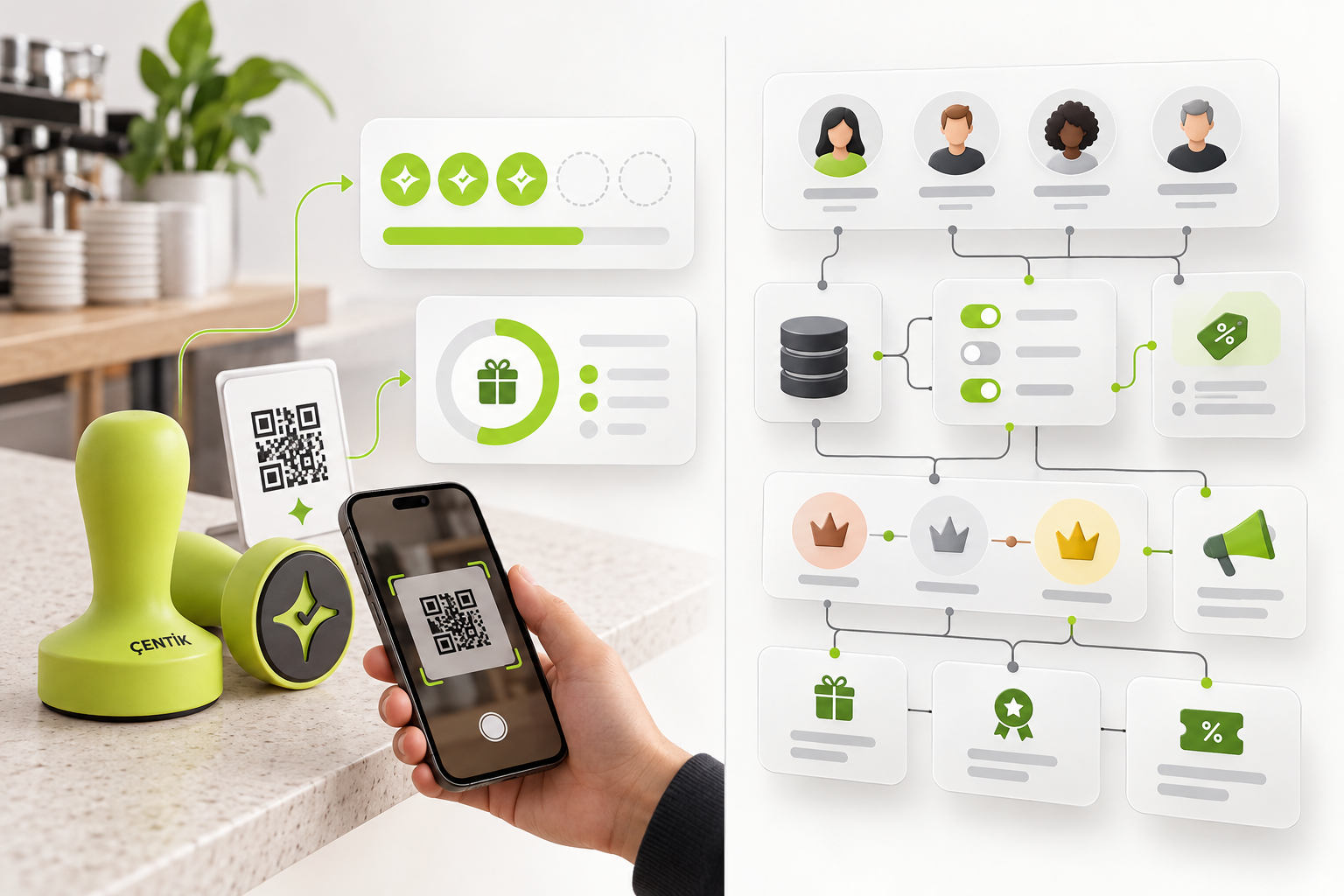
| Criterion | Çentik | Salesforce Loyalty Management |
|---|---|---|
| Primary audience | Independent cafés, restaurants, and smaller multi-location businesses | Organizations with complex loyalty, CRM, marketing, or partner requirements |
| Published pricing | $19.99/month for Pro, including the first location | Starter: $20,000/org/month; Growth: $35,000/org/month; Advanced: $45,000/org/month, billed annually[2] |
| Core reward mechanics | Count/stamp rewards and balance-based loyalty | Points, tiers, rewards, benefits, promotions, and configurable loyalty rules[1][2] |
| In-store earning | NFC tap, QR scanning, and counter-displayed QR workflows | Multiple loyalty engagement and integration options; particular checkout implementations require configuration[1][2] |
| POS-related workflow | Counter POS interface can display a QR code to grant a count or balance; optional amount-based balance through the QR flow | Documents POS integration kits and business APIs, subject to edition and implementation[2] |
| Customer experience | Browser-based loyalty interaction without requiring a dedicated app download | Configurable loyalty experiences, member portals, widgets, and mobile development tools[1][2] |
| Program complexity | Focused on accessible, recurring-customer loyalty workflows | Advanced program administration, promotion rules, tiers, and partner management[1][2] |
| CRM and reporting | Customer records, visit tracking, repeat-visit insights, and campaigns | Salesforce-connected customer data, analytics, segmentation, and marketing workflows[1][2] |
| Multiple programs | Business and location-oriented loyalty management | Advanced edition explicitly supports multiple programs[2] |
| Referral and partner workflows | Enterprise referral and partner capabilities are not established | Partner management is edition-dependent; Salesforce also markets a broader referral solution[1][2] |
| Best-fit buying process | Businesses evaluating a focused loyalty subscription | Organizations evaluating an enterprise platform and a sales-led implementation |
Which Loyalty Platform Should You Choose?
Choose Çentik if your immediate goal is to make repeat visits measurable and rewarding at a physical location without building an enterprise loyalty infrastructure project. Choose Salesforce Loyalty Management if you need sophisticated loyalty rules, connected customer data, multiple programs, partner relationships, or enterprise-wide coordination. Salesforce has the broader documented enterprise feature set, while Çentik offers a more focused in-store proposition at a substantially lower published starting price. Neither is automatically better for every organization.[1][2]
How Çentik Works: NFC, QR, Count Rewards, and Loyalty Balances
Çentik supports two core reward models: count-based loyalty and balance-based loyalty. A business can reward qualifying customer interactions with counts or grant a loyalty balance, depending on its configured program. Customers can interact using NFC or QR. This gives businesses different ways to operate loyalty at a counter, rather than limiting them to traditional digital stamp cards.
NFC and QR Loyalty Interactions
Çentik provides an NFC touchpoint through its physical Damper device and supports QR-based customer interactions. A café might use a count-based offer that progresses toward a complimentary item. Another business might choose balance-based rewards. The appropriate model depends on the promotion and how the business wants customers to earn benefits.
Counter QR Codes and Amount-Based Balance Earning
Çentik can display a QR code through its counter POS interface to grant a count or a balance. In an optional configuration, the balance granted through that QR flow can be based on an amount received from the POS. This does not imply universal POS compatibility or automatic transaction synchronization. Merchants should confirm the operational workflow for their specific counter setup before deployment.
Why These Interactions Matter
A loyalty program has to work during ordinary customer transactions, not just in a marketing presentation. NFC and QR create visible interaction points for customers and employees. Count-based programs are intuitive for repeat purchases, while balance-based programs provide another approach when reward value is linked to customer activity. The benefit of either model depends on consistent staff use, understandable reward rules, and reliable validation.
How Salesforce Loyalty Management Works
Salesforce Loyalty Management takes a wider approach to loyalty operations. Salesforce describes a platform for B2C and B2B programs, including points, status tiers, rewards, configurable redemption rules, and connected member information. Organizations can design experiences around customer behavior, coordinate programs with customer-facing teams, and connect loyalty activities to other Salesforce capabilities. The edition purchased and the surrounding Salesforce products determine which functions are available.[1][2]
Points, Tiers, and Advanced Program Rules
Salesforce supports conventional points-based structures as well as tiered programs and other configurable mechanics. Its pricing documentation lists loyalty rules, promotion tooling, vouchers, benefits, engagement features, and tier management. This range is useful when a business needs different earning rules, qualification thresholds, member benefits, or promotion strategies across customer segments. Specific edition entitlements must be checked rather than assumed.[1][2]
Enterprise CRM, Marketing, and Partner Programs
Salesforce positions loyalty within a broader customer relationship ecosystem. It describes connections across marketing, sales, service, commerce, and partner activity, with configurable journeys and promotional experiences. Growth and Advanced editions include broader member, benefits, promotions, and partner administration than the Starter package. Advanced specifically addresses multiple loyalty programs on one platform. These capabilities can matter to retailers, hospitality groups, and other organizations coordinating loyalty across departments or business units.[1][2]
What Independent Review Evidence Shows
Gartner Peer Insights lists Salesforce Loyalty Management with a 4.4 out of 5 rating from 14 ratings in its Loyalty Program Vendors category. Its product overview describes personalized rewards, configurable program rules, segmentation, and integration with Salesforce products. The review sample is limited, and these ratings do not establish that Salesforce is better than Çentik. They provide third-party context for assessing enterprise usability and capabilities, not a direct head-to-head performance test.[3]
Pricing Comparison: $19.99 per Month vs Enterprise Licensing
Çentik Pro costs $19.99 per month for the first location. Salesforce publicly lists Loyalty Management Starter at $20,000 per organization per month, Growth at $35,000, and Advanced at $45,000, with annual billing. These are fundamentally different commercial offerings, not equivalent product bundles. Salesforce states that published prices are subject to change and that customers should contact sales for detailed pricing.[2]
| Plan | Published price | Relevant scope |
|---|---|---|
| Çentik Pro | $19.99/month | First location included; NFC and QR loyalty with count and balance reward options |
| Salesforce Loyalty Management Starter | $20,000/org/month, billed annually | Entry enterprise edition; published inclusions include Quick Promotions[2] |
| Salesforce Loyalty Management Growth | $35,000/org/month, billed annually | Broader member, reward, benefits, promotions, and partner administration; single-program setup[2] |
| Salesforce Loyalty Management Advanced | $45,000/org/month, billed annually | Multi-program setup and expanded enterprise capabilities[2] |
The difference in published subscription pricing is substantial, but price alone should not determine the choice. An enterprise buyer may require functions that are outside Çentik's intended scope. Conversely, paying for extensive program administration may offer little practical value to a single-location café. A purchasing decision should compare necessary features, staff workload, integration effort, ongoing administration, and total contractual commitments.
Implementation and Integration: Practical Differences
Çentik is a practical candidate when an operator wants customers to earn rewards through identifiable NFC or QR interactions at the counter. A merchant should still test device placement, QR presentation, employee permissions, reward validation, customer onboarding, and any intended POS-related workflow. Supporting a QR flow based on an amount received from a POS should not be confused with a guarantee of compatibility with a particular register or payment system.
Salesforce requires a different evaluation. Its public documentation identifies business APIs, POS integration kits, loyalty processing capabilities, and tools for designing member experiences. These features create opportunities for more comprehensive implementations, but a buyer must validate which components are included in the selected edition, which external systems are supported, what configuration work is necessary, and whether additional products or professional services are required. Salesforce's pricing materials explicitly discuss professional services, partners, support options, and additional products.[2]
Who Is Çentik Best For?
- Independent coffee shops that want a straightforward repeat-purchase reward program.
- Bakeries, neighborhood restaurants, and similar businesses that interact with returning customers at the counter.
- Small operators that prefer NFC or QR earning rather than a loyalty experience centered on a downloadable customer app.
- Businesses deciding between count-based incentives and balance-based rewards.
- Merchants looking for a loyalty subscription with a publicly stated $19.99 monthly Pro price for the first location.
- Owners who prioritize practical customer participation and day-to-day reward administration over enterprise loyalty architecture.
Çentik is less suitable when the essential requirements include complex partner settlement, multiple enterprise loyalty programs, advanced tier administration, or extensive CRM-native orchestration. Those needs should be evaluated against products explicitly built for enterprise loyalty management.
Who Is Salesforce Loyalty Management Best For?
- Large organizations operating complex loyalty programs across multiple teams or brands.
- Enterprises with an established Salesforce environment and a requirement to connect loyalty with broader CRM activity.
- Businesses requiring configurable points, tiers, promotions, benefits, and redemption rules.
- Organizations that need structured partner loyalty programs or multiple program administration.
- Teams prepared to evaluate enterprise licensing, system integration, professional services, and long-term administration.
- Businesses seeking a configurable loyalty platform rather than primarily an in-store NFC or QR reward touchpoint.
Salesforce's enterprise scope is a strength when the associated capabilities are necessary. It can also introduce more purchasing, configuration, and governance decisions than a smaller operator wants to manage. The right comparison is therefore not just feature count, but the fit between the operational problem and the platform being purchased.[1][2]
Limitations and Trade-Offs
Çentik Limitations
- Its primary proposition is focused physical-location loyalty, not a fully documented enterprise loyalty rules engine.
- Specific POS interoperability must be assessed individually.
- The existence of a POS-related QR flow does not establish payment processing or automatic transaction synchronization.
- Organizations requiring sophisticated tiers, partner programs, or enterprise-wide CRM orchestration should verify whether their requirements are covered before committing.
- A successful deployment still depends on employee adoption, reward economics, and customer participation.
Salesforce Loyalty Management Limitations
- Published entry pricing places it in a substantially different budget category from a small-business loyalty subscription.[2]
- Important functionality varies by edition, including partner administration and multi-program support.[2]
- Its publicly documented enterprise integration options do not guarantee compatibility with every checkout system.[2]
- Customers should assess implementation resources, administration requirements, and potential complementary products.
- An enterprise loyalty platform may be more extensive than necessary for a basic café visit-reward program.
Five Questions to Ask Before Making a Decision
- What reward model do you actually need: counts, loyalty balances, points, tiers, partner incentives, or several of these?
- Where will members earn rewards: at a counter, through a website, in an app, across connected channels, or through partners?
- Does earning need to depend on verified purchase amounts, and how will that data reach the loyalty system?
- Which teams will configure rules, approve rewards, measure results, and resolve customer issues?
- What is the full acceptable cost, including subscription commitments, implementation, integrations, employee time, and ongoing administration?
Moving Between Çentik and Salesforce Loyalty Management
Switching loyalty providers should be treated as a data and customer-experience project rather than a simple software replacement. Neither a direct migration connector between these products nor automatic transfer of balances and rewards has been established in this comparison. Before moving, organizations should establish what records can be exported and imported, how member identities will be matched, how existing rewards will be honored, and which permissions or customer communications must be reviewed.
Migration Checklist
- Inventory customer identifiers, enrollment records, reward counts, balances, and redemption histories.
- Confirm available export and import formats with both providers.
- Define a mapping between old and new reward rules before transferring any customer value.
- Validate how historical balances, earned benefits, and outstanding rewards will be treated.
- Review access permissions, customer notices, and applicable data-handling requirements.
- Pilot the replacement with a limited customer group and test earning, redemption, and reporting.
- Set a cutover plan that prevents duplicate earning or unintended reward loss.
Final Verdict: A Focused Loyalty Tool or an Enterprise Platform?
Çentik is the more relevant starting point for a small physical business that wants to reward repeat customers through NFC and QR interactions, using count-based or balance-based loyalty without purchasing an enterprise loyalty platform. Salesforce Loyalty Management is the stronger fit when the requirement is a broad, configurable loyalty architecture involving tiers, partners, sophisticated promotions, connected Salesforce data, or multiple programs. Salesforce provides substantially broader published enterprise capabilities, while Çentik addresses a narrower and more accessible use case. The best decision is the one that solves your actual customer-retention problem without paying for complexity you do not need.[1][2][3]
Frequently Asked Questions
Is Çentik better than Salesforce Loyalty Management for coffee shops?
For many independent coffee shops seeking practical in-store count or balance rewards, Çentik is likely the more appropriate product to evaluate first. Salesforce is more relevant when advanced enterprise loyalty requirements justify its scope and pricing. The final decision depends on the café's existing systems and reward requirements.
How much does Çentik cost?
Çentik Pro costs $19.99 per month for the first location.
How much does Salesforce Loyalty Management cost in 2026?
Salesforce publicly lists Starter at $20,000 per organization per month, Growth at $35,000, and Advanced at $45,000, all billed annually. Buyers should confirm current terms and any additional products or services with Salesforce.[2]
Does Çentik support both stamp rewards and balance-based loyalty?
Yes. Çentik supports count-based rewards and a balance-based loyalty model. NFC or QR interactions can grant a count or balance according to the configured program.
Can Çentik grant loyalty rewards through a POS-displayed QR code?
Yes. Its counter POS interface can display a QR code that grants a count or balance. An optional balance-earning configuration can use an amount received from the POS. Compatibility with a particular POS implementation should be confirmed separately.
Does Salesforce Loyalty Management support points and tiers?
Yes. Salesforce documents points, tier-based loyalty, reward rules, member benefits, and related promotion capabilities. Feature availability depends on the selected edition.[1][2]
Can Salesforce Loyalty Management handle multiple loyalty programs?
Yes. Salesforce specifically lists multiple-program setup for its Advanced edition. Organizations should review the edition comparison before purchasing.[2]
Does Çentik require customers to download an app?
No dedicated app download is required for Çentik's browser-based customer loyalty experience.
Does either platform work with every POS?
Universal POS compatibility should not be assumed for either product. Çentik offers NFC and QR workflows, including a counter QR option. Salesforce documents POS integration kits and APIs, but support and implementation requirements depend on the environment and selected capabilities.[2]
Is Salesforce Loyalty Management worth the higher price?
It can be appropriate when an organization needs advanced program configuration, CRM-connected experiences, multi-program administration, or partner management. Those capabilities may justify enterprise licensing for some businesses, but they are not automatically necessary for straightforward in-store rewards.
Can an enterprise migrate from Salesforce Loyalty Management to Çentik?
A migration may be possible depending on the records available and the target reward design, but a direct supported migration path has not been established. Confirm data portability, identity matching, reward liabilities, and operational requirements before making a switch.
Which product should a growing restaurant group consider?
A restaurant group focused on straightforward repeat visits, customer rewards, and in-store interactions should evaluate Çentik. A group needing complex tier logic, multiple enterprise programs, extensive cross-system integrations, or sophisticated customer journeys should also assess Salesforce Loyalty Management.
Make Repeat Visits More Rewarding with Çentik
Explore NFC and QR loyalty with count-based and balance-based rewards. See whether Çentik Pro at $19.99 per month for your first location fits your business before investing in a more complex loyalty platform.
Explore Çentik