
What is the main difference between Çentik and Shopify POS?
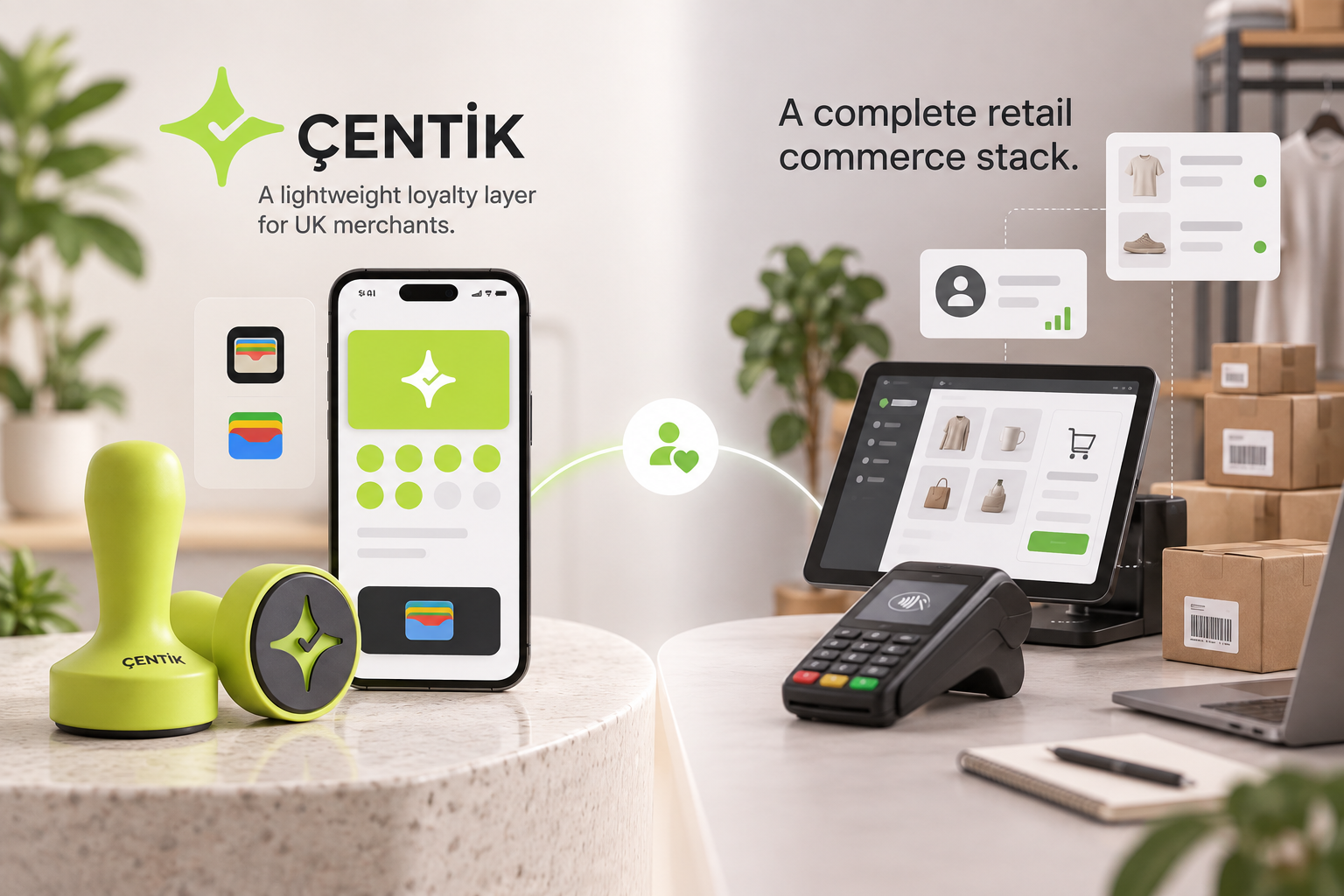
The shortest answer is that Çentik is primarily a loyalty and retention product, while Shopify POS is primarily a commerce and point-of-sale platform. Çentik’s public English product pages describe a no-download browser journey, Apple Wallet and Google Wallet support, an NFC counter touchpoint, QR, digital stamp cards, customer analytics, campaigns, barista accounts and multi-location support, with the loyalty layer able to run independently of the merchant’s existing POS. Shopify positions POS as the in-person extension of its commerce platform, synchronising orders, inventory and customer data across stores and online channels.

| Criterion | Çentik | Shopify / Shopify POS |
|---|---|---|
| Primary job | Dedicated loyalty and retention for cafés and repeat-visit local businesses; public pages focus on digital stamp cards, campaigns and repeat-visit analytics. | Full commerce and retail POS: checkout, payments, inventory, orders, customer profiles and online/in-store synchronisation. |
| Customer experience | No dedicated app required; loyalty opens in the browser and can be added to Apple Wallet or Google Wallet. | Customers do not need the Shopify POS merchant app. The loyalty experience itself depends on the merchant’s chosen Shopify configuration and, for points/rewards programmes, often a loyalty app from the Shopify ecosystem. Shopify’s App Store has a dedicated POS-rewards category. |
| In-store loyalty touchpoint | Verified first-party flow includes Çentik Stamp NFC tap and QR; both update the same digital card. | Shopify provides POS hardware and contactless payment capabilities, but the reviewed first-party documentation did not show a native loyalty-stamp touchpoint equivalent to Çentik Stamp. Loyalty-specific hardware or flows should be verified app by app. |
| Customer data | Customer profiles, visit history, returning-customer analytics and campaign segments are documented on Çentik’s public pages. | Shopify POS customer profiles can store contact details, purchase history, marketing preferences and custom metafields; POS Pro can make customer capture recommended or required. |
| Omnichannel commerce | Not positioned as an ecommerce, inventory or payment operating system; it is designed to sit beside the existing POS. | A core strength: Shopify POS connects in-store and online sales, customer data, inventory and orders in one commerce back office. |
| Loyalty programme depth | Verified public offer centres on stamp-based rewards, multiple reward tiers, birthday, win-back and double-stamp campaigns. | Shopify provides customer profiles, segments, discounts, gift cards and extensibility; dedicated points, VIP and POS reward mechanics can be added through many third-party loyalty apps. |
| POS dependency | Can run without replacing the current POS. | Shopify POS is itself the POS layer and is most differentiated when used with the Shopify commerce back office. |
| Extensibility | Focused product surface; integration claims should be verified individually before sale. | Very broad app and developer ecosystem; Shopify says POS can be customised with apps and custom solutions, and the App Store includes hundreds of POS-reward listings. |
| UK pricing structure | A 30-day no-card trial is consistently documented, but Çentik’s current English homepage and English pricing page show inconsistent live price figures; verify the canonical UK price before publication. | UK pricing is a Shopify plan plus any POS Pro, hardware, payment and third-party app costs. Shopify’s UK POS page currently lists Basic from £25/month on monthly billing and POS Pro at an additional £69/month per location; annual pricing differs. |
| Best fit | Operators that want to add a visible loyalty layer quickly without replacing their current till or asking customers to install another app. | Retailers that want online and physical commerce, inventory, payments and customer records to operate in one Shopify stack, with loyalty added as part of that environment. |
Where Çentik is the more natural fit
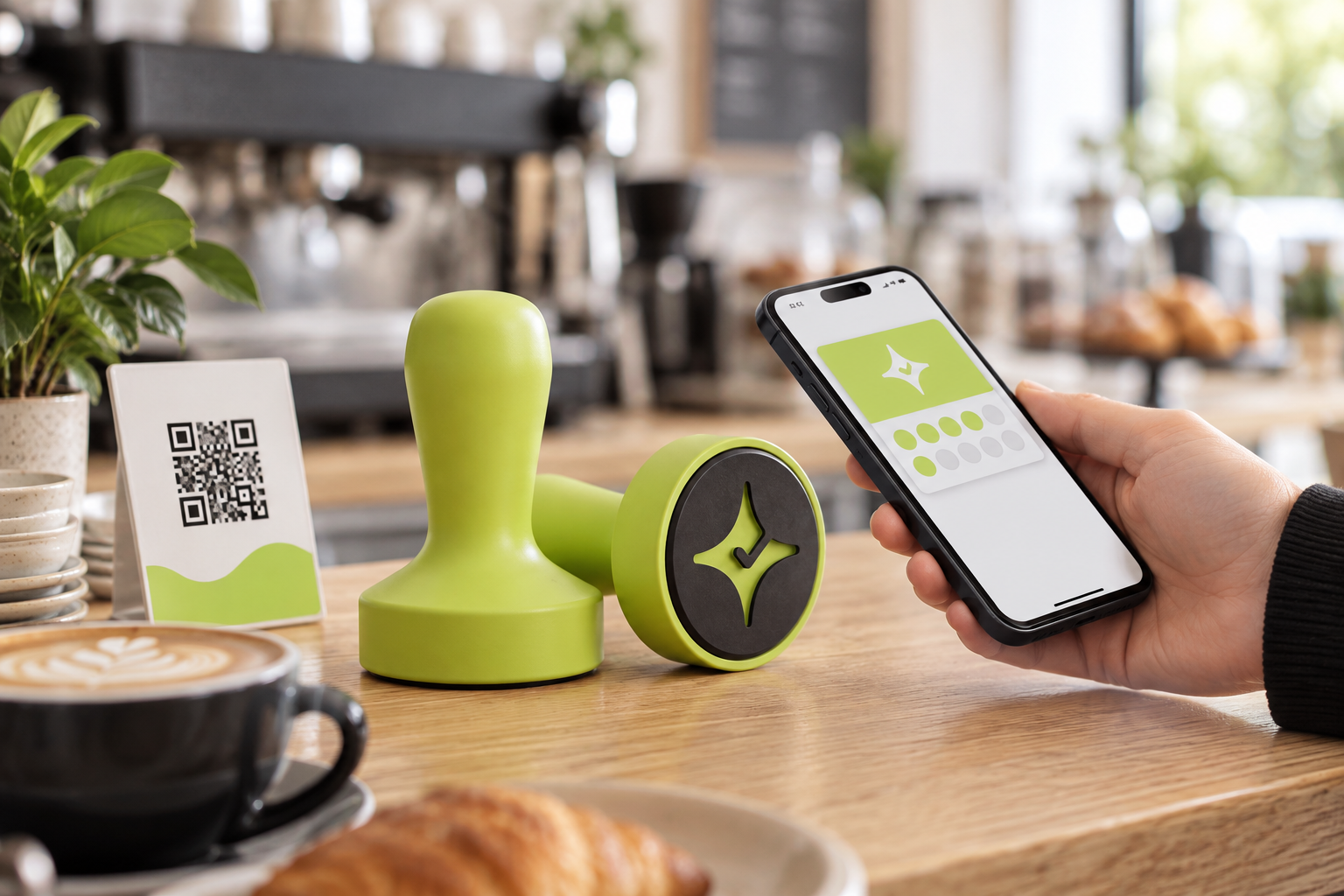
Çentik is the more natural fit when loyalty is the project rather than the entire commerce stack. Its strongest verified use case is a café or other repeat-visit venue that wants a low-friction counter ritual: the customer taps the physical Çentik Stamp or uses QR, the loyalty card updates in the browser, and the same card can live in Apple Wallet or Google Wallet. The merchant can track repeat behaviour and run documented campaign types such as double stamps, win-back and birthday rewards. The operational advantage is independence: the public how-it-works page explicitly says the system runs independently of the POS.
Counter experience: loyalty tap is not the same as contactless payment
Shopify supports modern payment hardware and contactless checkout, but payment NFC should not be presented as the same thing as Çentik’s loyalty NFC. Çentik documents a dedicated loyalty touchpoint whose purpose is to advance the customer’s digital stamp card. In this comparison, that distinction matters: a merchant can keep its current payment stack and still place a separate loyalty interaction on the counter.
Where Shopify POS is the more natural fit
Shopify POS is the more natural fit when the business wants one commerce system across web and physical retail. Shopify’s first-party documentation emphasises unified inventory, orders, payments, customer data, staff workflows and omnichannel services such as pickup and ship-to-customer. For a retailer already running Shopify ecommerce, that shared back office can reduce duplicated catalogue and customer administration. This is materially broader than a loyalty-only deployment, but it also means the decision can involve POS hardware, payments, staff permissions, inventory processes and migration of operational data—not just rewards.
How loyalty works around Shopify POS
Shopify POS has strong first-party customer-management primitives: profiles can store contact information, purchase history, marketing preferences and custom metafields, while Shopify’s marketing stack supports segmentation, email, automations, discounts and gift cards. For specialist points, VIP tiers or POS rewards, Shopify’s own App Store exposes a dedicated loyalty-and-rewards category filtered for POS rewards, showing that merchants can extend the core platform rather than being limited to one loyalty engine. That flexibility is valuable, but the exact customer journey, pricing, data model and migration path then depend on the selected app.
Pricing: compare the total stack, not just one subscription
A direct monthly-price headline would be misleading. Shopify’s UK POS pricing currently starts with a Shopify subscription and can add POS Pro at £69 per month per location, with hardware, payment processing and loyalty-app costs depending on the setup; Shopify also publishes different effective subscription prices for annual billing. Çentik consistently advertises a 30-day free trial, but its current English homepage and English pricing page display different live prices, so this page should not claim a UK price advantage until the canonical UK price is aligned across homepage, pricing, checkout and structured data.
Who each option is best for
- Choose Çentik when the existing POS is staying, the core goal is repeat visits, the venue wants a browser/Wallet loyalty journey, and a dedicated NFC-or-QR counter interaction is part of the desired experience.
- Choose Shopify POS when the business wants in-store sales, ecommerce, inventory, orders, payments and customer profiles unified in the Shopify stack, especially where omnichannel retail is central.
- Consider Shopify plus a loyalty app when a Shopify-native commerce stack is already non-negotiable and the merchant needs deeper points, VIP, referral or ecommerce loyalty mechanics than Shopify’s core customer-management features provide.
- Consider Çentik as a separate loyalty layer when replacing POS would create disproportionate cost or disruption and the business mainly wants a fast retention programme rather than a new commerce platform.
Limitations to understand before choosing
Çentik is not a substitute for a full retail operating system. Its public pages do not position it as an inventory, ecommerce checkout or payment-processing platform, and public documentation for a one-click Shopify migration or a broad integration catalogue was not verified in this research. Shopify POS, meanwhile, is broader than many cafés need if their only problem is loyalty, and its specialist loyalty experience can vary substantially by third-party app. Neither product should be described as universally better; the right architecture depends on whether commerce or retention is the primary system of record.
Migration from Shopify or Shopify POS to Çentik
Shopify can export customer profiles to CSV, and the export can include customer tags and supported metafields. Its customer CSV model also includes marketing-preference fields such as whether the customer accepts email marketing. That gives a useful starting point, but loyalty value may live outside the standard Shopify customer record—for example in a third-party loyalty app or app-specific metafields—so the source of truth must be identified before promising a balance or points migration.
- Export customers, tags, relevant supported metafields and the available marketing-preference fields from Shopify; separately obtain any loyalty-app export required for points, tiers or rewards.
- Deduplicate customer identities before import and define how email, phone and account identifiers will map into Çentik.
- Reconcile every loyalty balance or reward state against the source system before cutover; do not infer missing balances.
- Preserve opt-out states and any available consent provenance. Do not convert unknown or opted-out records into marketing consent.
- Run a sample migration first, compare record counts and reward totals, then perform a short parallel validation period before retiring the old loyalty workflow.
- Because a public one-click Shopify-to-Çentik importer was not verified, confirm the accepted Çentik import format and operational migration support before publishing a 'seamless migration' claim.
UK marketing consent and customer-data considerations
Loyalty migration is not only a technical exercise. The ICO states that electronic direct marketing must comply with PECR and data-protection rules, that consent must be freely given, specific, informed and unambiguous where consent is relied on, and that organisations should respect opt-outs and keep records of how marketing permissions were obtained. In practice, treat identity data, loyalty balances and marketing permissions as separate migration fields. A successful account transfer does not automatically create a lawful marketing permission.
Independent review signal for Shopify POS
Capterra currently shows Shopify POS at 4.6/5 from 248 reviews, with the page last updated 16 September 2026; it also reports 4.6 for ease of use and 4.4 for customer service. This is useful as an external sentiment signal, not as a UK-specific benchmark or proof that every merchant will have the same experience. The strongest recurring use case visible in both first-party and review material is the convenience of connecting physical selling with an existing Shopify commerce operation.
Decision criteria for a UK operator
- Is the project primarily about retention, or are you replacing the POS and commerce stack?
- Must customers avoid installing a dedicated loyalty app?
- Do you want a physical loyalty tap point at the counter, separate from payment?
- Is unified ecommerce and store inventory more important than POS independence?
- Where will loyalty balances live, and can they be exported cleanly?
- Which marketing permissions can be lawfully carried forward under UK GDPR and PECR?
- What is the true annual cost after POS software, hardware, payment fees and any loyalty app?
Verdict: two different architectures for customer retention
For a UK café or repeat-visit venue that already has a workable till and wants to add loyalty without changing it, Çentik’s verified proposition is the cleaner architectural fit: browser-first loyalty, Wallet access, NFC and QR, campaigns and repeat-visit analytics around the existing POS. For a retailer that wants ecommerce, in-store sales, inventory, payments and customer records unified in one platform, Shopify POS is the broader commerce choice, and loyalty can be layered on through Shopify’s customer tools and app ecosystem. The deciding question is therefore not 'Which brand is bigger?' but 'Which layer of the stack are you actually trying to replace?'
Is Çentik a replacement for Shopify POS?
Not in the full POS sense. Çentik is positioned as a loyalty and retention layer that can run independently of the existing POS, whereas Shopify POS processes in-person sales and connects them to Shopify’s commerce back office.
Does Shopify POS include a loyalty programme?
Shopify POS includes customer profiles, purchase history, marketing preferences, discounts, gift cards, segments and extensibility. For dedicated points, VIP and POS-reward mechanics, Shopify also has a large third-party loyalty app ecosystem. The exact loyalty programme therefore depends on the merchant’s chosen setup.
Do Çentik customers need to download an app?
No dedicated Çentik app is required for the verified public flow. The loyalty card opens in the browser and can also be added to Apple Wallet or Google Wallet.
Can a Shopify merchant keep Shopify and still use a separate loyalty platform?
Shopify POS is designed to be extended with apps and third-party tools. Whether a specific external loyalty platform integrates directly should be verified product by product; Çentik’s public positioning confirms it can run independently of a POS, but a native Shopify integration was not verified in this research.
Can Shopify customer data be exported for a migration?
Yes. Shopify documents customer CSV export, including optional tags and supported metafields. Marketing-preference fields are part of the customer data model, but any loyalty balance held by a third-party app may require a separate export.
Which is cheaper in the UK?
This page does not make a cheapest claim. Shopify costs depend on the Shopify plan, POS Pro, hardware, payment processing and any loyalty app.
Add loyalty without rebuilding your till
If your priority is a fast, app-free loyalty layer for a café or repeat-visit venue, explore Çentik’s NFC, QR, browser and Wallet experience and validate the fit with your current counter workflow.
Explore Çentik