
Çentik vs Comarch Loyalty: the direct answer
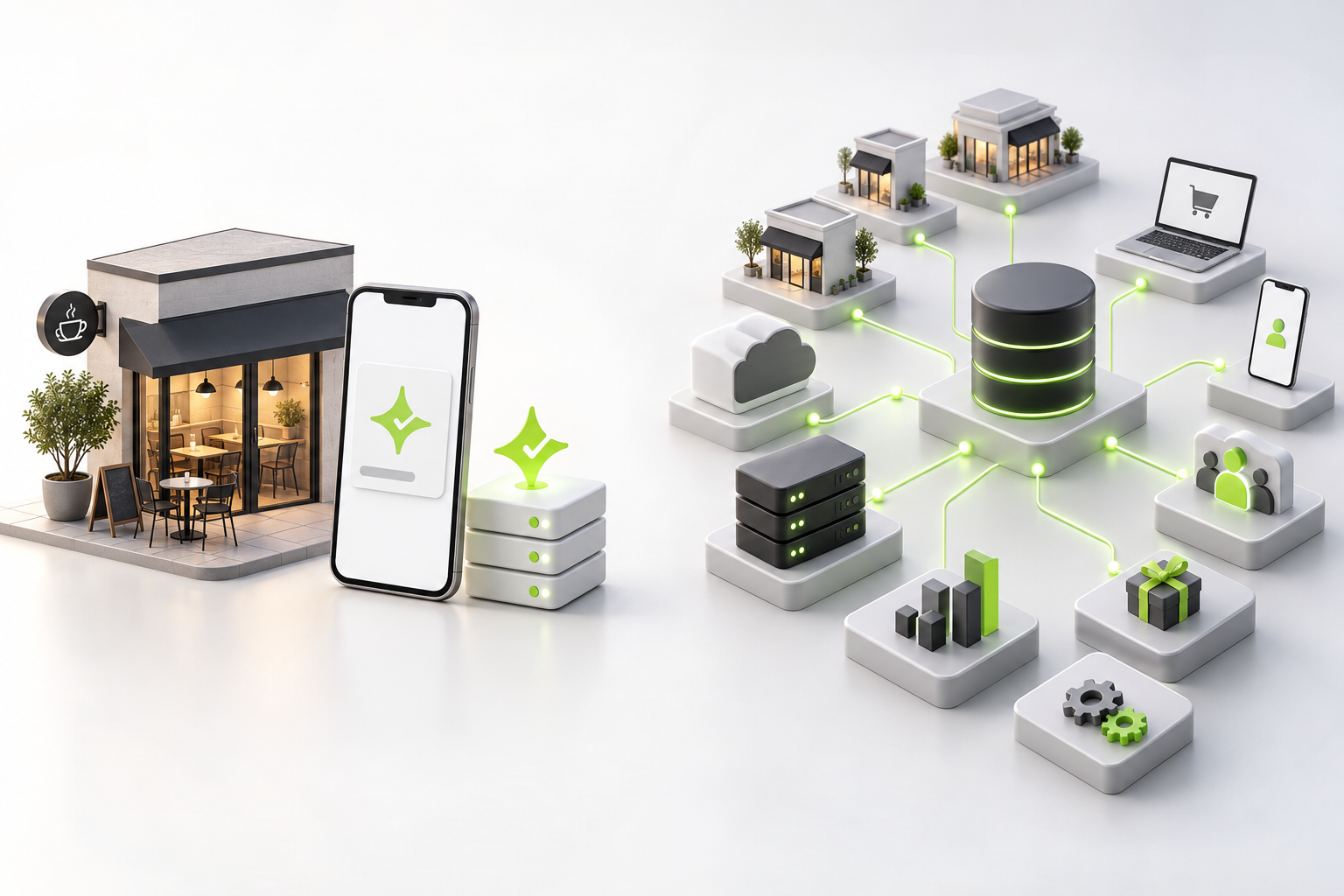
For an independent café, bakery, restaurant or small multi-site operator that wants to launch loyalty without changing its till or asking customers to install another app, Çentik is designed around a much lighter deployment model. Its public product pages describe NFC and QR earning, browser-based cards, Apple Wallet and Google Wallet, customer management, campaigns, analytics and QR Menu Pro. Comarch Loyalty Management addresses a materially broader programme-management problem: its public documentation covers configurable promotions, gamification, tiers, referrals, rewards management, analytics, AI, fraud controls and integrations with existing enterprise systems.
| Criterion | Çentik | Comarch Loyalty |
|---|---|---|
| Typical positioning | Lightweight loyalty and retention for cafés, restaurants and repeat-visit local businesses | Configurable loyalty infrastructure for larger and more complex programmes |
| Public pricing model | $19.99/month is currently shown on the pricing page, with the first location included and additional locations at $4.99/month; however, the English homepage simultaneously shows $9.99/month, so the canonical UK price should be confirmed before publication | Tailored pricing based on selected modules, programme scale/member volume and integration complexity |
| Mandatory customer app | No; the loyalty experience can open in the browser | Not inherently confirmed as mandatory; Comarch offers a loyalty mobile application and can integrate customer experiences into existing web/mobile environments |
| Apple Wallet / Google Wallet | Both are publicly documented | Not confirmed in the reviewed public product material; verify for the proposed implementation |
| NFC / physical counter touchpoint | Dedicated Çentik NFC counter device plus QR | No equivalent dedicated NFC counter device was verified in the reviewed sources; channel integrations should be confirmed during solution design |
| QR | Customer QR workflow is publicly documented | Specific small-merchant QR workflow should be verified for the intended deployment |
| Core loyalty mechanics | Digital stamps and reward tiers; current public pages focus primarily on café-style repeat visits | Points, discounts, coupons, product rewards, tier systems and activity-triggered promotions |
| Gamification and referrals | Not presented as a major current public capability | Badges, progress mechanics, leaderboards, competitions and member-get-member referrals are documented |
| Rewards operations | Merchant-defined loyalty rewards | Broader rewards management, catalogues, marketplace options and fulfilment capabilities |
| Analytics | Customer, repeat-visit and campaign-oriented analytics | Programme analytics, BI, behavioural analysis, financial/liability reporting and AI-supported analysis |
| Integrations | Designed to operate without requiring a POS integration | API-centric and designed to integrate into existing enterprise and MarTech environments |
| POS dependency | No POS connection required | Not inherently tied to one POS; integration scope depends on the programme architecture |
| Programme scale | Best understood from current public material as an SMB-focused product | Comarch explicitly markets the platform for large-scale and complex loyalty deployments |
| UK presence | Çentik's public pricing page identifies a Turkish operating company | COMARCH UK LTD is an active UK company incorporated in 2012 |
| Procurement style | Self-serve trial and subscription-led onboarding | Discovery, tailored quotation and RFI/RFP-led enterprise procurement are publicly offered |
What Comarch Loyalty Management actually offers
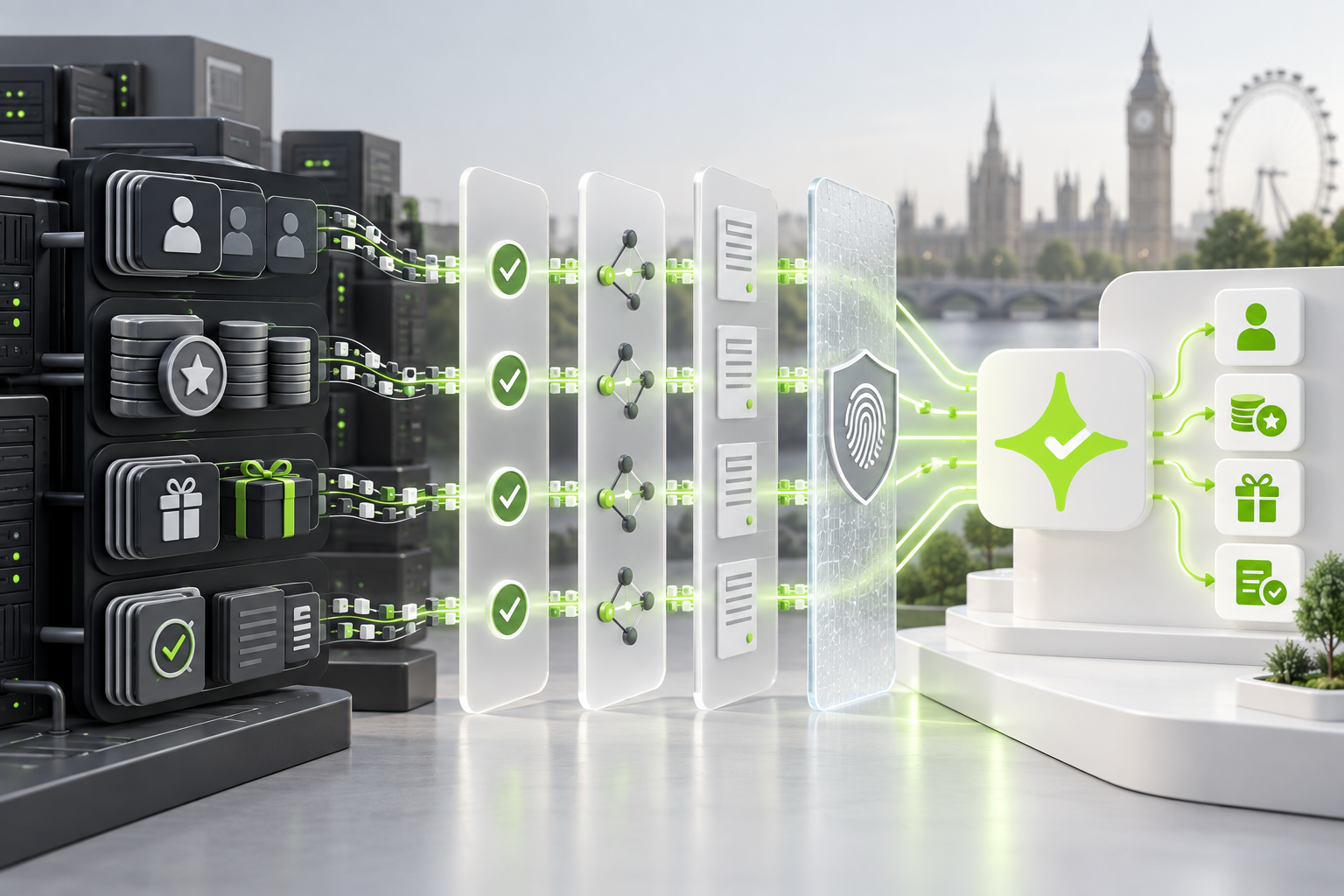
Comarch Loyalty Management is not simply a digital stamp-card product. Comarch documents a promotion engine capable of rewarding different customer activities, tier structures, referrals, gamification, rewards management, customer-data analysis, AI-supported personalisation, fraud detection and integrations with other systems. It also offers programme-management services and business-intelligence capabilities, including reports around reward liabilities and programme economics.
Its customer references also show the type of environment it targets. Comarch lists organisations including Heathrow Airport, BP, JetBlue, Deutsche Bahn and other large brands as loyalty clients. Heathrow independently confirms that Heathrow Rewards remains an active programme with points earning, vouchers, premium status and airline-partner conversion, although Heathrow's public consumer page does not identify the underlying technology supplier.
Where Çentik is deliberately simpler
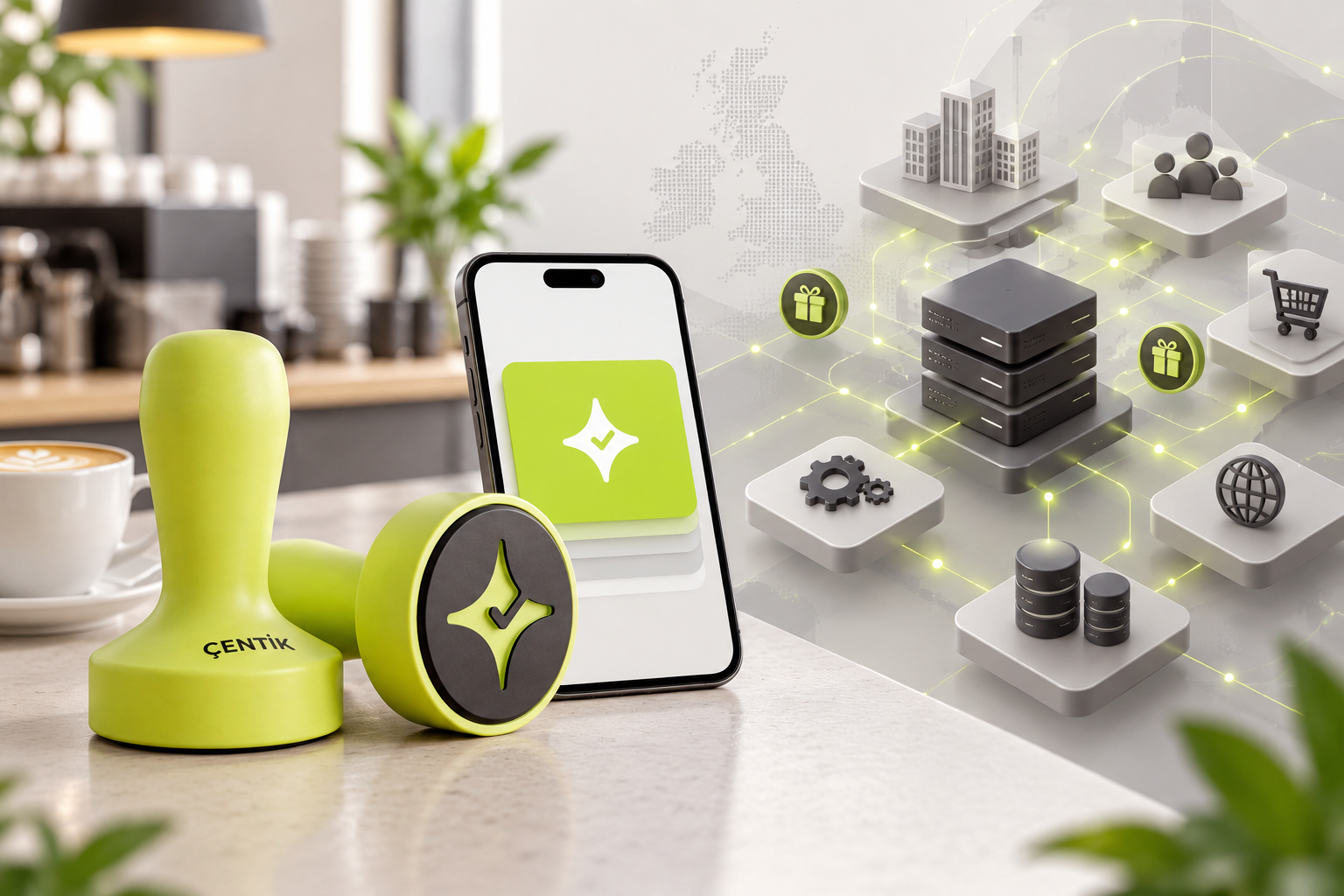
Çentik's current public journey is built around reducing friction at the counter. A customer can tap the physical Çentik point or use QR, receive a digital loyalty card without downloading a dedicated application, and optionally keep that card in Apple Wallet or Google Wallet. The merchant can run loyalty independently of the existing till, while the same subscription also exposes customer-management, campaign, analytics and QR-menu functions.
- Choose Çentik when the primary requirement is a fast, visible loyalty interaction at the physical venue rather than a large custom loyalty transformation.
- Choose Çentik when keeping the current POS or payment provider is a priority; Çentik explicitly says a POS connection is not required.
- Choose Çentik when avoiding a compulsory customer-app download is important; its browser and Wallet flows are publicly documented.
- Consider Comarch when loyalty must span multiple brands, countries, customer channels or complex reward economics and must integrate deeply with an established enterprise stack.
- Consider Comarch when advanced gamification, referral logic, rewards fulfilment, fraud controls, extensive configuration or programme-level BI are core requirements rather than future nice-to-haves.
Where Comarch has materially deeper capabilities
Comarch's strongest differentiation is breadth and configurability rather than a café counter interaction. Public documentation describes tiered programmes, paid or invitation-only member groups, member-get-member referrals, gamification, reward catalogues, behavioural and transactional incentives, advanced analytics, fraud detection and integrations across a wider technology estate. For organisations designing a multinational or multi-brand programme, those capabilities can be more relevant than the speed of deploying a single digital stamp card.
Pricing and procurement are fundamentally different
Comarch does not publish one universal subscription fee for Loyalty Management. Its public pricing explanation says cost is tailored according to modules, programme scale/member volume and integration complexity, and the site provides discovery and RFI/RFP routes. Çentik's pricing page currently lists Pro at $19.99 per month for the first location and $4.99 for each additional location, with a 30-day trial and no credit card. There is, however, a current publishing inconsistency: Çentik's English homepage shows $9.99 per month while its dedicated pricing page shows $19.99. That discrepancy should be resolved before using a definitive price claim in UK acquisition campaigns.
Implementation and migration considerations
Moving from Comarch or another enterprise loyalty platform to a lighter system should not be treated as a simple CSV import. Before migration, map member identities, current balances or points, tier status, outstanding rewards, expiry dates, transaction history, campaign permissions, suppression records and any partner-linked liabilities. Decide which records must be preserved operationally and which are retained only for statutory, contractual or audit purposes. Run balance reconciliation before cutover, test a representative customer cohort, define a rollback process and keep a signed migration ledger.
- Identity mapping: define the canonical customer identifier and safely deduplicate accounts before import.
- Balance mapping: document precisely how points, stamps, monetary balances or tier progress convert; do not silently change value.
- Rewards: identify issued but unused vouchers, entitlements and expiry rules before switching systems.
- Consent: migrate the provenance, timestamp, channel and withdrawal status of marketing permissions rather than importing a bare email or phone list.
- Integrations: catalogue every POS, ecommerce, CRM, app, data warehouse, rewards partner and reporting dependency before decommissioning the previous stack.
- Customer communication: explain material programme changes clearly, including any effect on balances, rewards, privacy choices or account access.
UK GDPR and PECR considerations
The loyalty-platform decision is also a data-governance decision. ICO guidance explains that electronic direct marketing is governed by PECR alongside data-protection rules, including consent and applicable soft-opt-in requirements. The ICO separately provides rules for restricted transfers of personal information outside the UK, including adequacy mechanisms, appropriate safeguards such as the UK IDTA or Addendum where relevant, and transfer-risk assessment. Neither vendor should be described as automatically making a merchant compliant: the actual controller/processor roles, lawful basis, consent capture, suppression process, hosting, subprocessors and international data flows must be assessed for the specific deployment.
Evidence beyond vendor marketing
Comarch has an established UK corporate presence: Companies House lists COMARCH UK LTD as active, incorporated on 20 March 2012, with a London registered office. Independent software-review evidence exists but is limited in volume: G2 displayed 10 reviews for Comarch Loyalty Management at the time of research, with reviewers discussing flexibility, integrations and implementation experiences. That sample is useful as qualitative context but is too small to treat as a definitive measure of customer satisfaction.
Which option fits which buyer?
Çentik is the more directly aligned option for a UK independent café, bakery, dessert shop, restaurant or small physical chain whose priorities are app-free onboarding, an NFC or QR counter interaction, native mobile-wallet access, straightforward merchant operations and loyalty that can sit beside the existing POS. Comarch is more naturally aligned with organisations that need configurable programme architecture across larger customer bases, complex integrations, multiple reward types, tiers, referrals, gamification, fraud controls or international programme operations. This is a fit distinction, not a claim that one platform is universally superior.
Limitations to check before signing
For Çentik, confirm the canonical subscription price, current multi-location availability, UK contractual/data-transfer arrangements, the exact campaign-delivery channels required and any integration needs that go beyond its POS-independent workflow. The current English pages contain a pricing inconsistency and mixed language around multi-location availability, so those items should be verified directly before procurement.
For Comarch, request a scoped commercial proposal rather than assuming SaaS-style list pricing. Verify the modules included, implementation services, integration responsibilities, hosting and support model, customer-facing surfaces, Wallet requirements, migration responsibilities and total cost over the expected programme term. Comarch itself states that pricing varies with modules, scale and integration complexity.
Decision checklist for UK teams
- Do customers need a dedicated app, or should browser and Wallet access be enough?
- Is the programme primarily a simple repeat-visit mechanic or a configurable points, tier, referral and promotions ecosystem?
- Must loyalty operate independently from the current POS and payment provider?
- How many locations, brands, countries and customer identities must the platform support?
- Are advanced rewards fulfilment, gamification, fraud detection or partner settlement required?
- Which systems need real-time or batch integration?
- What customer data, balances, rewards and consent history must migrate?
- What UK GDPR, PECR and international-transfer controls are required for the chosen architecture?
- Does the organisation prefer self-serve subscription procurement or a discovery, implementation and RFP process?
- What is the full three-year cost including integrations, implementation, support, hardware and internal operating effort?
Is Comarch Loyalty Management aimed only at large enterprises?
Comarch says its software can scale across different programme sizes, but its current marketing, tailored pricing model, RFI/RFP process, extensive integration capabilities and named customer examples strongly position it toward complex and enterprise use cases. Smaller organisations should request a scoped proposal rather than assuming the platform is unsuitable.
Does Comarch require customers to download an app?
The reviewed sources do not establish a universal mandatory-app requirement. Comarch offers a loyalty mobile application and also describes integration with existing digital environments. The exact customer journey should be confirmed for the proposed implementation.
Does Çentik require a POS integration?
No. Çentik's public FAQ states that it can run independently of the till, so a merchant does not have to change its current POS setup.
Does Çentik support Apple Wallet and Google Wallet?
Yes. Çentik's English product page explicitly documents both Apple Wallet and Google Wallet support.
How much does Comarch Loyalty cost?
Comarch does not publish one standard fee in the material reviewed. It says pricing depends on the modules selected, programme scale or member volume and integration complexity, and directs buyers to request a tailored quote.
How much does Çentik cost in the UK?
Çentik's dedicated English pricing page currently lists $19.99 per month for the first location and $4.99 per additional location, but the English homepage simultaneously shows $9.99 per month.
Can an enterprise loyalty programme be migrated from Comarch to Çentik?
Potentially, but only when the destination product covers the required programme mechanics. Migration should reconcile customer identities, balances, rewards, expiry rules, consent records and integrations before cutover. Complex tiers, partner settlement, large reward catalogues, advanced gamification or other Comarch-specific programme logic may require redesign rather than a direct one-to-one migration.
Which platform is better for an independent coffee shop?
For a coffee shop whose requirements are app-free customer onboarding, NFC or QR loyalty, Apple or Google Wallet access and operation without changing the POS, Çentik directly documents those workflows. A coffee business needing enterprise-level programme configuration, complex integrations, advanced gamification or extensive reward operations should also evaluate Comarch against those requirements.
See whether Çentik fits your loyalty setup
If you want a lightweight loyalty layer that works alongside your existing till, compare your current programme requirements with Çentik's NFC, QR, browser and Wallet workflow before committing to a larger enterprise implementation.
Explore Çentik