
Quick answer: Çentik and Como are built for different buying motions
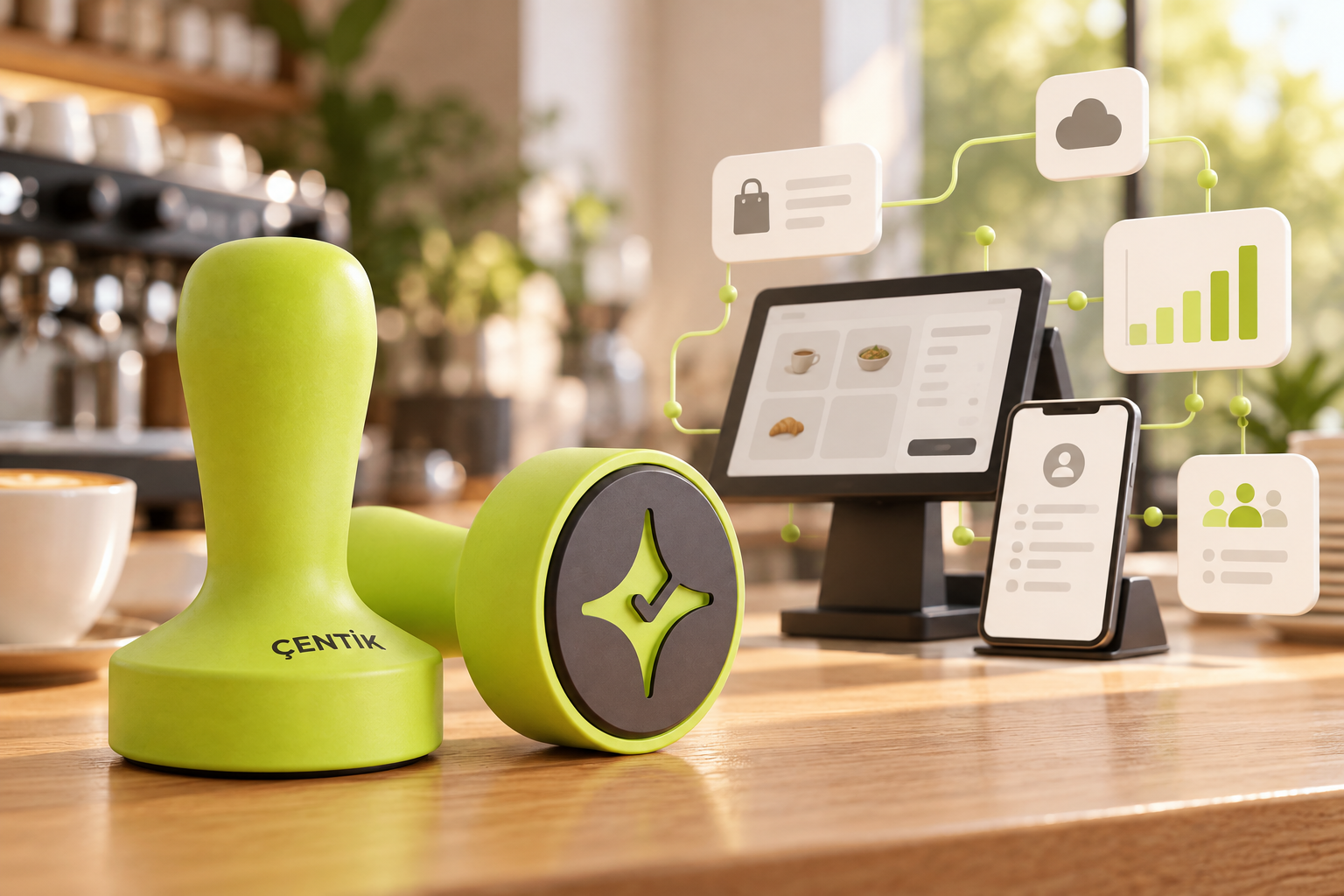
Çentik is the more lightweight proposition in the public materials reviewed: customers can use a browser-based loyalty card, Apple Wallet or Google Wallet, and earn through QR or the physical Çentik Stamp without the merchant replacing its POS. Como is positioned as a broader customer-engagement platform that connects loyalty with POS data, branded mobile experiences, a web customer portal, marketing automation, APIs, wallet passes, payments and online ordering. Como’s own site says it connects technologies such as POS, online ordering, apps, websites and Wi-Fi, while its current integration page promotes 90+ POS integrations. Sources: centik.app/en, comosense.com/, comosense.com/pos-integration/

| Criterion | Çentik | Como |
|---|---|---|
| Primary fit | Independent cafés, coffee shops and repeat-visit SMBs that want a simple loyalty layer without changing POS | F&B and retail brands that want a broader customer-engagement stack with deep POS and channel connectivity |
| Customer experience | Browser-first digital card; no dedicated app required; Apple Wallet and Google Wallet; QR and physical NFC Çentik Stamp | Branded mobile app, customer portal, wallet pass, POS registration and other configurable member journeys |
| Loyalty models | Public site emphasizes digital stamps, reward tiers, customer profiles and campaign-based retention | Points, digital punch cards, cashback, tiers, referrals, subscriptions, promo codes and configurable rewards |
| POS dependency | Core public flow works independently of the merchant’s till | Public positioning emphasizes connected POS and transaction data; vendor promotes 90+ POS integrations |
| Marketing | Customer segments plus first-visit, double-stamp, win-back and birthday campaigns | Rule-based marketing automation, granular segmentation, campaign templates and omnichannel engagement |
| Integrations and API | No public integration catalog comparable to Como’s was found in the materials reviewed | Large public POS integration catalog plus APIs and webhooks documented in the knowledge center |
| Public pricing | Dedicated pricing page lists $19.99/month for the first location, $4.99/month per additional location, and a 30-day trial with no credit card | No public list price was found on the vendor site reviewed; Como directs buyers to request a demo, and G2 also lists pricing as unavailable |
| Buying motion | Self-serve trial is publicly offered | Sales-led demo/contact flow is prominent |
Where Çentik is a strong fit
Çentik makes the most sense when the goal is to launch a recognizable loyalty program without rebuilding the restaurant technology stack. Its public product pages describe an app-free browser flow, Apple Wallet and Google Wallet access, QR, and the physical NFC Çentik Stamp. The dedicated pricing page also bundles loyalty, customer management, campaigns, analytics, QR Menu Pro, barista accounts and multi-location support into one Pro plan. That combination is especially relevant to owner-operated cafés and small chains that care about speed of rollout, a physical in-store touchpoint and predictable public pricing. Sources: centik.app/en, centik.app/en/pricing
- Choose Çentik when avoiding a mandatory customer app is important.
- Choose Çentik when you want a physical NFC counter touchpoint plus QR rather than making loyalty depend on POS integration.
- Choose Çentik when a transparent entry price and a self-serve trial are important parts of the buying decision.
- Choose Çentik when the loyalty program can stay comparatively simple: stamps, rewards, customer profiles, segments and retention campaigns.
Where Como is a strong fit
Como’s public product set is materially broader. Its personalized-loyalty page documents points shops, digital punch cards, cashback, tier programs, referrals, mobile wallet functionality, subscriptions and promo codes. Its marketing-automation page describes rule-based automations and 70+ pre-made templates, while its product pages also cover branded mobile apps, online ordering, digital payments and omnichannel communication. For restaurant groups that want loyalty to sit inside a larger customer-data and transaction ecosystem, those capabilities can matter more than a minimal launch flow. Sources: comosense.com/personalized-loyalty/, comosense.com/marketing-automation/, comosense.com/branded-mobile-app/
- Choose Como when loyalty must use rich POS and purchase data across a more integrated stack.
- Choose Como when you need advanced program mechanics such as cashback, membership tiers, subscriptions, referrals or gamified experiences.
- Choose Como when a branded app, web portal, wallet pass, API/webhook layer and larger integration program are part of the requirement.
- Choose Como when the project is expected to involve a sales, implementation and integration process rather than a simple self-serve rollout.
App, web, wallet and in-store touchpoints
The clearest difference is not simply “app versus no app.” Çentik explicitly says customers do not need to install an app: the loyalty card opens in the browser and can also live in Apple Wallet or Google Wallet. Como does offer a branded mobile app, but its current documentation also shows a configurable web Customer Portal, wallet passes that can be distributed by URL, and registration through the web, POS, API or import. In other words, Como can support non-app journeys too. In the public materials reviewed, however, no Como-owned NFC countertop device directly analogous to the supplied Çentik Stamp was found. Sources: centik.app/en, comosense.com/branded-mobile-app/, knowledge.comosense.com/hc/en-us/articles/38902032334098-Customer-Portal-Homepage, knowledge.comosense.com/hc/en-us/articles/6742892433170-Como-Wallet-Pass
Loyalty design and marketing depth
Çentik’s public site emphasizes a focused set of repeat-visit mechanics: digital stamps, multiple reward tiers, customer segments, repeat-visit analytics, first-visit offers, double-stamp periods, win-back campaigns and birthday campaigns. Como publishes a much wider configuration surface, including points, punch cards, cashback, membership tiers, referrals, subscriptions, coupons, event-based rewards, gamification and rule-based marketing automation. That does not make one model universally better; it means buyers should decide whether flexibility is central to the program or whether additional configuration would create unnecessary operating overhead. Sources: centik.app/en/pricing, comosense.com/personalized-loyalty/, comosense.com/marketing-automation/
POS integration, data and APIs
Çentik’s public positioning is intentionally POS-independent: its core loyalty flow can run without connecting to the till. Como takes the opposite architectural emphasis. Its website says it connects POS, online ordering, app, website and Wi-Fi data, and promotes 90+ POS integrations. Como’s knowledge center also documents transaction-aware APIs and a September 2026 Export Event API that can stream member registrations, consents, profile changes, purchases, redemptions, punch-card events and point transactions to external systems. Buyers that require tight purchase-level orchestration should verify their exact POS and API use case with Como; buyers that specifically want to avoid a POS project may find Çentik’s standalone model simpler. Sources: centik.app/en, comosense.com/, comosense.com/pos-integration/, knowledge.comosense.com/hc/en-us/articles/38418741011858-Export-Event-API-Webhooks
Pricing and procurement
Çentik’s dedicated international pricing page currently lists Pro at $19.99 per month with the first location included, additional locations at $4.99 per month, a 30-day free trial with no credit card, and one Çentik NFC device included with shipping. Como does not publish a standard list price on the vendor pages reviewed and instead directs prospects to request a demo. G2’s current Como profile likewise says pricing details are not available. For a fair budget comparison, a U.S. buyer should request a Como quote that includes platform fees, implementation, integrations, messaging or add-ons, and any location-based charges that apply to the intended configuration. Sources: centik.app/en/pricing, comosense.com/, g2.com/products/como/reviews
Limitations and trade-offs to check before buying
- Çentik does not publicly document an integration catalog comparable with Como’s 90+ POS claim, so restaurants that need transaction-level loyalty automation should verify integration requirements before choosing it.
- Çentik’s public product pages do not advertise the same breadth of advanced mechanics Como publishes, such as cashback, subscriptions, gamification and a branded native app.
- Como’s public pricing is not transparent, so total cost cannot be compared fairly without a current quote for the exact U.S. deployment.
- Como’s flexibility can involve more configuration and integration decisions; treat that as a project-planning consideration rather than assuming a simple plug-and-play deployment.
Who each option is best for
Çentik is best aligned with independent coffee shops, cafés, bakeries and smaller restaurant groups that want a visible in-store loyalty touchpoint, an app-free customer journey, simple retention campaigns and a public entry price without making POS integration a prerequisite. Como is better aligned with brands that need loyalty to be deeply connected to POS and customer data, want more advanced program design and marketing automation, or require a branded app, broader integrations and API-driven workflows. If your operation sits between those profiles, the deciding question is usually whether integration depth is worth the additional implementation and procurement effort.
Migration from Como to Çentik: what to validate
A Como-to-Çentik migration should be treated as a data-mapping project, not a simple account transfer. Como’s current documentation shows CSV member imports that can carry member details, points, credit, external IDs, tags and some preference data, and it separately documents consent states and event exports. Before leaving Como, confirm what data can be exported from your specific contract and configuration. Then map only the fields and loyalty constructs that have an intentional destination in Çentik; do not assume that complex tiers, subscriptions, gamification, custom assets or automation rules will have one-to-one equivalents. Sources: knowledge.comosense.com/hc/en-us/articles/360014474079-Import-Members, knowledge.comosense.com/hc/en-us/articles/360004002753-Member-Consent-to-T-C, knowledge.comosense.com/hc/en-us/articles/38418741011858-Export-Event-API-Webhooks
- Inventory customer profiles, unique identifiers, point or credit balances, punch-card progress, rewards, tags, consent states and location mappings.
- Export a small test cohort first and reconcile totals before moving the full database.
- Document which Como mechanics have a direct Çentik equivalent and which should be simplified or retired.
- Preserve consent provenance and suppression preferences instead of treating marketing permission as a generic profile field.
- Run parallel validation for balances and reward eligibility before the cutover date.
Evidence quality and what was not claimed
Como’s public documentation is extensive, but some claims on its marketing pages are vendor claims rather than independent measurements. This page therefore uses those materials to describe product capabilities, not to repeat performance claims. Independent directory evidence is also limited: G2 currently shows only five Como reviews, so its rating is too small a sample to treat as a broad quality verdict. Capterra’s September 2026 profile corroborates Como’s positioning around loyalty, campaigns, POS support and third-party integrations, but catalog data should still be checked against the vendor for a live U.S. deployment. Sources: g2.com/products/como/reviews, capterra.com/p/10033324/Como/
Is Como a direct alternative to Çentik?
Yes, in the broad sense that both can run customer loyalty for food-and-beverage businesses. They are not identical products: Çentik is positioned around a lightweight browser, wallet, QR and NFC loyalty flow, while Como is a broader customer-engagement platform with deeper POS connectivity, program configuration and automation.
Does Como require customers to download an app?
Not necessarily. Como markets a branded mobile app, but its documentation also describes a web Customer Portal, wallet passes, POS registration and web/API registration flows. The exact member journey depends on how the merchant configures the program.
Does Çentik require POS integration?
No for the core public flow. Çentik says its loyalty system can run independently of the merchant’s till, using the browser-based customer card, QR and the physical Çentik Stamp.
Which platform has broader loyalty mechanics?
Como publicly documents a broader set of program mechanics, including points, punch cards, cashback, tiers, referrals, subscriptions, promo codes and gamification. Çentik’s public pages focus on digital stamps, reward tiers, customer segments and retention campaigns.
Which platform publishes pricing?
Çentik publishes a U.S.-dollar price on its dedicated pricing page. Como did not show a standard public list price in the vendor pages reviewed and uses a demo/contact-sales flow.
Can I migrate customer data from Como to Çentik?
Potentially, but it should be scoped field by field. Before migration, export and validate customer identifiers, balances, reward progress, consent records, tags and location mappings, then confirm which constructs have supported equivalents in Çentik.
What should a U.S. restaurant ask Como before signing?
Ask for the exact POS integration scope, implementation timeline, U.S. pricing, included messaging volumes, add-on fees, API access, data-export process, support model and how existing loyalty balances and consent records would be migrated.
What should a U.S. restaurant ask Çentik before signing?
Confirm the current canonical monthly price, multi-location rollout status, any integration needs beyond the standalone flow, migration support for existing balances or stamps, and the number of physical NFC devices required per location.
See whether Çentik fits your loyalty workflow
If your priority is an app-free loyalty program that can start without replacing your POS, review Çentik’s current product and trial details before comparing a custom Como quote.
Explore Çentik