
Çentik vs Open Loyalty: The Quick Verdict
Çentik is the more natural starting point for an independent coffee shop, bakery, cafe, or smaller hospitality business that wants customers to earn rewards through physical in-store interactions. Its NFC and QR workflows support both count-based rewards and balance-based loyalty. Open Loyalty is better aligned with organizations that need a configurable loyalty engine connected to their existing digital infrastructure. Its published capabilities include points, multiple loyalty wallets, tiers, referrals, challenges, rewards, and API-driven integrations.[1][2]

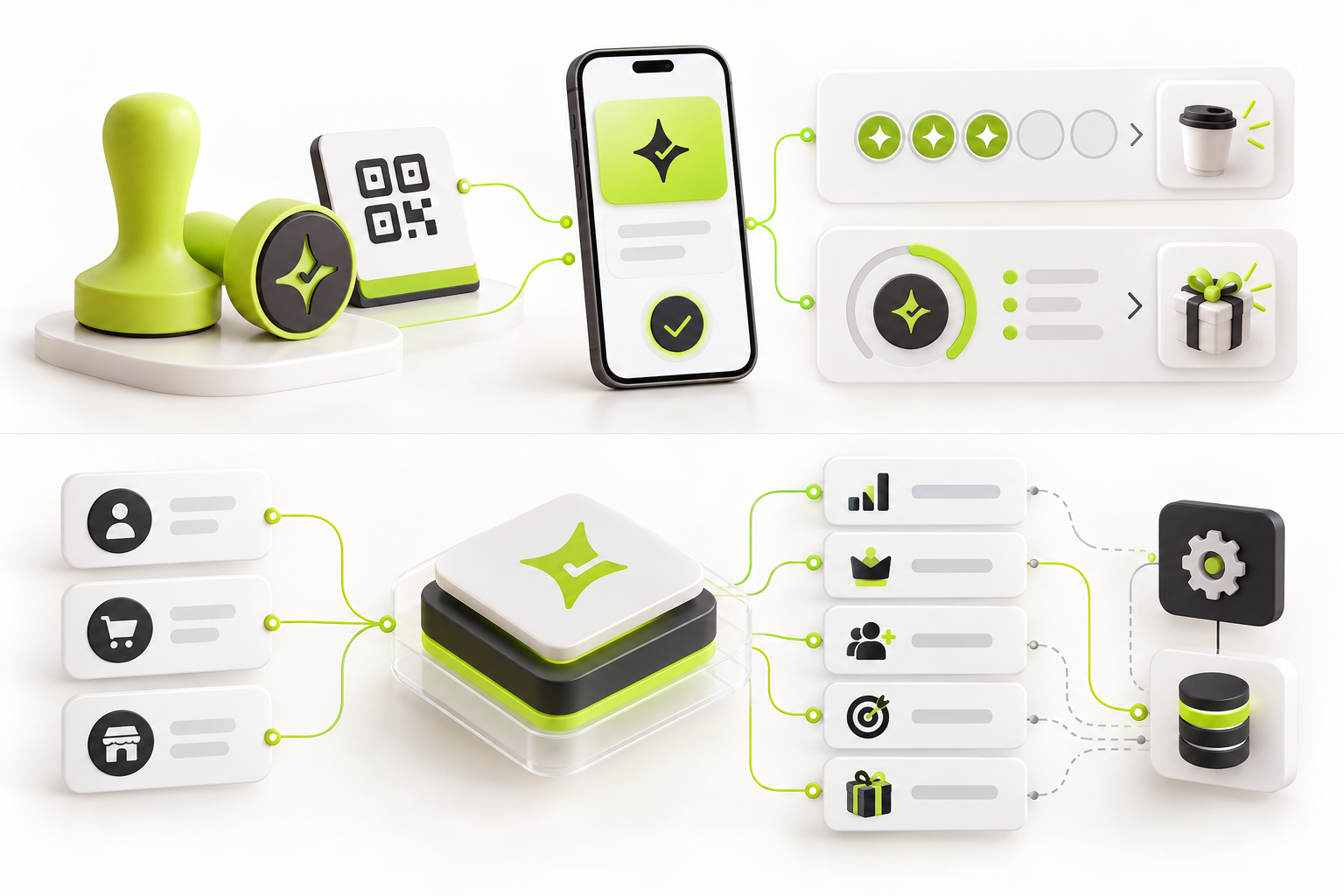
The distinction is not that Çentik only supports stamps or that Open Loyalty only supports points. Both can support more than one loyalty mechanic. The larger difference is product architecture: Çentik emphasizes a ready-to-use merchant and customer experience, while Open Loyalty emphasizes programmable loyalty infrastructure. Businesses should evaluate the total implementation effort, not just the feature checklist.
Çentik vs Open Loyalty: Feature Comparison
| Criterion | Çentik | Open Loyalty |
|---|---|---|
| Primary positioning | In-store digital loyalty for cafes, hospitality, and customer-facing businesses | API-first loyalty and gamification engine for configurable programs |
| Typical best fit | Independent businesses and smaller multi-location operators | Organizations with complex loyalty requirements and technical resources |
| Loyalty mechanics | Count/stamp rewards and balance-based loyalty | Points, multiple wallets, tiers, rewards, referrals, badges, challenges, and gamification |
| Customer earning methods | NFC interactions and QR code workflows | Loyalty events and transactions processed through connected systems and APIs |
| At-counter workflow | NFC touchpoints and QR-based reward or balance granting | Can support in-store loyalty through an appropriately implemented integration |
| POS relationship | Can operate without a POS integration; a counter interface can display a QR code and optionally use a POS-provided amount to determine the granted balance | API-first architecture for connecting loyalty logic with POS and other business systems |
| Customer mobile app | No dedicated customer app download required | Customer-facing experiences can be implemented through connected applications and channels |
| Digital wallet experience | Apple Wallet and Google Wallet loyalty card support | Multiple loyalty wallets within its loyalty engine; consumer wallet-pass functionality should be evaluated separately |
| Customer management | Customer profiles, repeat-visit tracking, segmentation, and campaigns | Member management, loyalty events, segmentation, and configurable program mechanics |
| Advanced gamification | Count and balance rewards with promotional campaigns | Documented capabilities include tiers, referrals, challenges, badges, leaderboards, and games |
| Implementation approach | Merchant-oriented setup with QR and NFC customer touchpoints | Technical integration project using APIs and administrative tools |
| Multi-location operations | Supports multiple business locations | Supports multiple projects and tenants with configurable deployments |
| Published pricing | $19.99/month for the first location | Custom pricing based on a platform fee and an allowance fee linked to monthly active members |
| Pricing predictability | Published first-location subscription price | Requires a tailored commercial quotation |
| Trial | 30-day free trial | No free trial listed on G2 |
| Primary evaluation priority | Counter workflow, customer adoption, reward economics, and daily usability | Integration scope, flexibility, scale, data architecture, and total project cost |
The comparison reflects published product descriptions and pricing information, including Open Loyalty's official platform and pricing pages, Çentik's public product information, and independent software directory listings. Feature availability, contractual commitments, and implementation requirements should be evaluated for the specific deployment.[1][2][3][4][5]
What Is Çentik?
Çentik is a digital loyalty platform built around the everyday experience of earning rewards at a business. A customer can interact with an NFC touchpoint or use a QR code to receive loyalty credit. Businesses can configure count-based reward programs, such as earning a reward after a certain number of qualifying purchases, or use a balance-based loyalty model. Both earning approaches are designed to support repeat visits and ongoing customer engagement.[3]
NFC, QR, and Balance-Based Rewards
Çentik supports several earning workflows. An NFC interaction can grant a count or loyalty balance under the business's configured rules. QR codes can also be used to grant either type of loyalty credit. At the counter, a POS-facing interface can display a QR code for the customer to scan. In an optional amount-based workflow, the balance granted through that QR interaction can be calculated using an amount received from the POS. This does not mean that Çentik automatically synchronizes with every POS system or processes the underlying payment.
For example, a cafe might reward every qualifying coffee purchase with one digital count toward a free drink. Another business might prefer a balance-based program governed by its own earning and redemption rules. The choice affects how customers understand progress, how rewards are budgeted, and how staff explain the program.
Designed for the Customer Experience at the Counter
Çentik provides a browser-based customer experience without requiring a dedicated app download. Its published capabilities also include Apple Wallet and Google Wallet cards, customer profiles, repeat-visit reporting, campaigns, QR menus, and multi-location management. For an independent business, bringing these functions into a merchant-facing product can be more practical than engineering a separate loyalty experience from an API platform.[3]
What Is Open Loyalty?
Open Loyalty is a composable, API-first loyalty platform built to help organizations create and operate configurable rewards and engagement programs. Its published product capabilities cover loyalty points, multiple wallets, tier progression, rewards, referral mechanics, badges, challenges, leaderboards, and additional gamification experiences. The company positions the platform as a loyalty engine that organizations can connect to existing applications and business systems.[1]
Enterprise Loyalty Infrastructure and APIs
Open Loyalty's architecture is designed to separate loyalty logic from other parts of an organization's technology stack. Developers can use its APIs to connect the loyalty engine to applications, POS environments, ecommerce platforms, CRM systems, and marketing tools. Its administrative interface supports managing loyalty mechanics without requiring every campaign adjustment to become a new software-development project. Actual integration work depends on the buyer's systems and requirements.[1][2]
Advanced Loyalty and Gamification
Open Loyalty offers a broader documented library of gamification mechanics than Çentik. These include progression tiers, behavioral challenges, incentivized referrals, achievement badges, leaderboards, reward catalogs, and game-oriented promotions. This flexibility is especially relevant when loyalty needs to influence multiple customer behaviors across ecommerce, physical locations, and digital products.[1]
Independent software marketplace Capterra lists Open Loyalty with a 4.8 out of 5 overall rating from 15 reviews in its August 2026 update. That is useful third-party context, but the relatively small review sample should not be treated as conclusive evidence of performance for every organization.[4][5]
NFC and QR Loyalty vs API-Driven Loyalty
The biggest operational difference between Çentik and Open Loyalty is how businesses are expected to deliver the loyalty experience. Çentik provides direct in-store earning methods through NFC and QR interactions. Open Loyalty provides configurable loyalty mechanics and APIs that can power customer-facing experiences built or integrated by the organization. These approaches can solve similar retention goals, but they involve different implementation responsibilities.
Example: An Independent Coffee Shop
- With Çentik, the cafe can introduce digital count rewards through an NFC or QR touchpoint and let customers follow their progress without downloading a dedicated app.
- The same cafe can choose a balance-based program instead of a traditional stamp count, depending on its desired reward economics.
- A counter-facing QR workflow can grant a count or balance; optional amount-based balance granting depends on the relevant POS amount being available to that workflow.
- With Open Loyalty, a business could develop a customized loyalty experience using the platform's points, wallet, and reward mechanics, but the customer journey and integrations would need to be designed and implemented.
- For a small team without dedicated development resources, the scope of the Open Loyalty implementation may be greater than the business requires.
Example: A Multi-Brand Retail or Restaurant Group
A business group operating several brands, applications, and sales channels might need unified loyalty rules across different systems. Open Loyalty's API-first architecture, multi-tenant capabilities, tier logic, and broader gamification toolkit make it a more appropriate product to evaluate for this requirement. Çentik supports multiple locations, but that should not be confused with a documented enterprise integration layer capable of replacing all the functionality of a composable loyalty engine.[1][2][3]
Çentik vs Open Loyalty Pricing in 2026
Çentik Pro costs $19.99 per month for the first location and offers a 30-day free trial. Open Loyalty does not publish a comparable fixed monthly subscription price. Its pricing page describes a combination of a platform fee and an allowance fee determined by monthly active members. A member is generally considered active when they perform at least one qualifying loyalty event during a calendar month, although the contractual definition can vary.[2]
| Pricing factor | Çentik | Open Loyalty |
|---|---|---|
| Entry price | $19.99/month for the first location | Custom quotation |
| Primary pricing structure | Published subscription price for the first location | Platform fee plus allowance fee based on monthly active members |
| Free trial | 30 days | G2 lists no free trial |
| Integration cost | Evaluate any requirements beyond the standard merchant workflow | Account for technical integration, development, testing, and maintenance |
| Budgeting approach | Begin with first-location subscription costs and evaluate operational requirements | Request a quotation based on program scale and implementation scope |
These prices should not be interpreted as equivalent packages. Open Loyalty includes enterprise-oriented infrastructure and configurable mechanics that may be valuable for organizations with complex requirements. Conversely, a smaller business may not benefit enough from those capabilities to justify a customized implementation. G2 confirms that buyers need to contact the Open Loyalty vendor to establish commercial terms.[2][6]
How to Compare Total Cost of Ownership
- Subscription or platform fees: Calculate the contract cost over the intended evaluation period.
- Implementation: Include software configuration, integration development, testing, and launch preparation.
- Hardware and touchpoints: Evaluate the equipment and counter experience needed for the selected earning method.
- Ongoing management: Include staff training, reward administration, customer support, and software maintenance.
- Reward liability: Estimate the cost of issued rewards, expected redemptions, and unused balances or credits under the program rules.
- Measurement: Track repeat purchase behavior, redemption, participation, and incremental gross profit rather than relying on enrollment alone.
Which Platform Is Easier to Implement?
For a straightforward in-store rewards program, Çentik presents a more immediately applicable operating model: configure the business, establish a reward program, introduce QR or NFC earning, and train counter staff. Its browser-based customer experience reduces the need to build a separate mobile application. That does not eliminate onboarding, staff training, testing, or the need to confirm hardware and device compatibility.[3]
Open Loyalty is designed around a different implementation model. Its loyalty engine connects to a company's existing systems through APIs, and the vendor describes technical consultants and implementation support as part of its offering. The work may involve identity mapping, event ingestion, loyalty rules, reward redemption, data governance, and integration testing. The exact workload depends on the selected architecture and should be established during technical discovery.[1][2]
Where Çentik Has the Stronger Fit
- Independent cafes and coffee shops looking to replace paper loyalty cards with digital count rewards.
- Businesses that want to offer balance-based loyalty alongside or instead of count-based rewards.
- Merchants that want QR or NFC earning at a physical counter.
- Teams seeking a customer-facing loyalty experience without commissioning a standalone mobile application.
- Operators that want a published first-location price and a free trial.
- Small hospitality businesses that need customer, repeat-visit, and campaign tools alongside the earning experience.
Çentik should not be selected solely because it is less expensive at the published entry level. A buyer should also test the actual earning workflow, staff permissions, redemption controls, reporting, supported devices, and any POS-related requirements. Businesses needing complex tier structures, sophisticated referral systems, custom loyalty event orchestration, or extensive enterprise integrations may require a different platform or additional development.
Where Open Loyalty Has the Stronger Fit
- Enterprise organizations building loyalty programs across multiple applications or business channels.
- Retailers and digital businesses that require API-based event processing.
- Teams designing tier progression, challenge-based engagement, advanced referrals, or gamification campaigns.
- Organizations with developers, integration partners, or internal architecture resources.
- Multi-brand operators requiring configurable tenants, loyalty rules, and data separation.
- Businesses that need a composable loyalty engine rather than a primarily counter-oriented merchant product.
Open Loyalty's published strengths do not automatically make it the better choice for every company. A programmable platform introduces more design choices, and those choices can create additional delivery responsibilities. However, for an organization whose loyalty requirements extend far beyond in-store stamps or balances, that configurability may be the primary reason to choose it.[1][2]
Limitations and Trade-Offs
Çentik Limitations to Consider
Çentik is not presented here as a replacement for a full enterprise loyalty architecture. Its public positioning emphasizes in-store customer engagement, digital rewards, merchant operations, and customer retention. Businesses requiring custom API orchestration, complex partner networks, advanced gamification, or deeply connected omnichannel customer journeys should validate those requirements individually. NFC also depends on appropriate devices and a usable in-store interaction flow.[3]
Open Loyalty Limitations to Consider
Open Loyalty's public materials emphasize an API-based engine rather than a standardized NFC device and merchant counter package. Buyers should not assume that selecting Open Loyalty automatically provides an equivalent physical tap device, customer-facing QR journey, or turnkey cafe loyalty experience. The needed interface and integrations must be established in the implementation scope. Its custom commercial model also means the total price cannot be determined from a single published subscription figure.[1][2]
Switching from Open Loyalty to Çentik, or from Çentik to Open Loyalty
Migration should begin with data portability and reward obligations, not with the design of a new loyalty card. Switching loyalty platforms can affect member identities, existing balances, accumulated counts, earned rewards, customer consent, and staff workflows. Neither a direct Open Loyalty-to-Çentik migration tool nor a guaranteed reverse migration should be assumed without confirmation.
A Practical Loyalty Migration Checklist
- Inventory current customers, loyalty identifiers, program rules, point or count balances, reward entitlements, and expiration policies.
- Confirm what the existing platform permits you to export and which relevant fields the destination platform can import.
- Define whether legacy points or balances will be transferred, converted, honored separately, or retired under disclosed program terms.
- Check customer consent, privacy notices, and applicable data-handling obligations before transferring records.
- Test earning and redemption with a limited set of accounts before wider rollout.
- Document edge cases, including duplicate identities, partially completed rewards, refunds, and disputed balances.
- Train staff and explain to customers how their existing benefits will be preserved or changed.
- Maintain appropriate records for reconciliation and customer support.
For a business moving from a sophisticated enterprise program to a simpler counter-based program, the critical question is whether the new system can preserve the customer benefits that matter. For a growing business moving toward an API-first platform, the critical question is whether the additional flexibility justifies migration complexity and ongoing engineering costs.
How to Choose the Right Loyalty Platform
Choose based on the experience you want customers to have, the loyalty logic your business requires, and the resources available to operate it. A smaller cafe might prioritize an uncomplicated earning moment and visible progress toward a reward. An enterprise may prioritize centralized rule management across multiple products, regions, and touchpoints. Neither requirement is inherently more sophisticated from the customer's perspective.
Five Questions to Ask Before Buying
- Do customers primarily earn rewards in a physical location, online, in an app, or across several channels?
- Do we need count-based rewards, loyalty balances, points, tiers, referrals, challenges, or a combination?
- Can our team implement and maintain API integrations, or do we need a more complete merchant-facing workflow?
- What should a cashier, barista, or customer do to earn and redeem a reward?
- What are the total costs of operating and funding the program, and how will we measure incremental repeat business?
Frequently Asked Questions
Is Çentik better than Open Loyalty for a small coffee shop?
Çentik is generally the more relevant product to evaluate first when a small coffee shop wants digital rewards using NFC or QR interactions without building a custom customer application. Open Loyalty is more appropriate when the business needs configurable loyalty infrastructure and has the resources to implement it.
How much does Çentik cost compared with Open Loyalty?
Çentik Pro costs $19.99 per month for the first location. Open Loyalty uses a custom pricing model based on platform and allowance fees tied to monthly active members, so an exact cost comparison requires a vendor quote.[2]
Does Çentik support balance-based loyalty or only digital stamps?
Çentik supports both. Businesses can use count-based rewards or a balance-based loyalty system. NFC and QR workflows can grant counts or balances according to configured business rules.
Can Çentik grant loyalty credit through a POS QR code?
Yes. A counter-facing interface can display a QR code that grants a loyalty count or balance. An optional workflow can determine the granted balance using an amount received from the POS. This does not establish universal POS compatibility or automatic synchronization.
Does Open Loyalty support points, tiers, and referrals?
Yes. Open Loyalty documents points, multiple wallets, tiers, referral mechanics, rewards, challenges, and other gamification capabilities.[1]
Does Open Loyalty offer NFC-based loyalty?
Open Loyalty's API-first architecture can support loyalty events from connected systems, but an equivalent ready-made NFC counter device is not established by the reviewed product documentation. Businesses requiring NFC should ask how the hardware, event processing, customer identification, and redemption workflow would be implemented.[1]
Do customers need to download an app to use Çentik?
No dedicated customer app download is required for Çentik's browser-based loyalty experience. Its published product information also describes Apple Wallet and Google Wallet card support.[3]
Is Open Loyalty open source?
No. Although its name may suggest otherwise, Open Loyalty explicitly describes its current product as Software as a Service rather than open-source software.[2]
Can Open Loyalty connect to a POS system?
Open Loyalty provides APIs intended for integration with business applications and systems, including POS environments. Actual compatibility and implementation requirements depend on the particular POS, available interfaces, and integration design.[1]
Can Çentik replace Open Loyalty for a large enterprise?
Not necessarily. Çentik may cover specific in-store loyalty workflows, but organizations using Open Loyalty for advanced tiers, referrals, gamification, multi-tenant operations, or custom API integrations must evaluate those requirements independently before considering a replacement.
Does Open Loyalty have a free trial?
G2's July 2026 pricing information states that Open Loyalty does not offer a free trial. Contact the vendor to ask about its current demonstration or evaluation arrangements.[6]
What should US businesses evaluate when comparing loyalty software?
US buyers should examine reward economics, operational usability, customer consent and privacy requirements, POS dependencies, implementation resources, reporting, technical support, and contractual terms. The best platform is the one that fits the business's actual retention strategy and operating environment.
Final Verdict: Çentik or Open Loyalty?
Choose Çentik when your priority is introducing practical digital loyalty at the counter with NFC and QR earning, count or balance rewards, and an accessible customer experience. Its published first-location price and free trial provide a straightforward starting point for smaller businesses. Choose Open Loyalty when the program depends on custom integrations, multiple loyalty mechanics, advanced gamification, and a configurable enterprise architecture. Its API-first design is an advantage when those capabilities are central to the project, rather than unnecessary complexity.[1][2][3]
For an independent US cafe or retailer evaluating its first digital loyalty program, Çentik is a sensible option to test. For an enterprise building an integrated loyalty ecosystem, Open Loyalty deserves a detailed technical and commercial evaluation. In both cases, judge success by customer participation, repeat behavior, reward economics, and the business value generated by the program.
Turn Everyday Visits Into Repeat Business With Çentik
Explore NFC and QR loyalty, digital stamp and balance rewards, and a customer experience that works without a dedicated app download. Start your 30-day free trial and see how Çentik fits your business.
Try Çentik Free for 30 Days