
Quick answer: Çentik and Voucherify solve different layers of loyalty
Çentik is a counter-first loyalty product aimed at cafés and other repeat-visit physical businesses: customers can earn via an NFC tap or QR flow, use a browser-based digital card, and add that card to Apple Wallet or Google Wallet without installing a dedicated customer app. Voucherify is an API-first incentive and loyalty engine designed to sit inside a broader commerce stack, with deeper rule configuration across loyalty, promotions, coupons, referrals, gift cards, wallets and multiple channels. For a UK independent venue that wants a ready-made in-store experience with minimal integration work, Çentik is the more direct fit. For a digital product or enterprise team that needs composable incentive logic across many systems and channels, Voucherify is structurally broader.

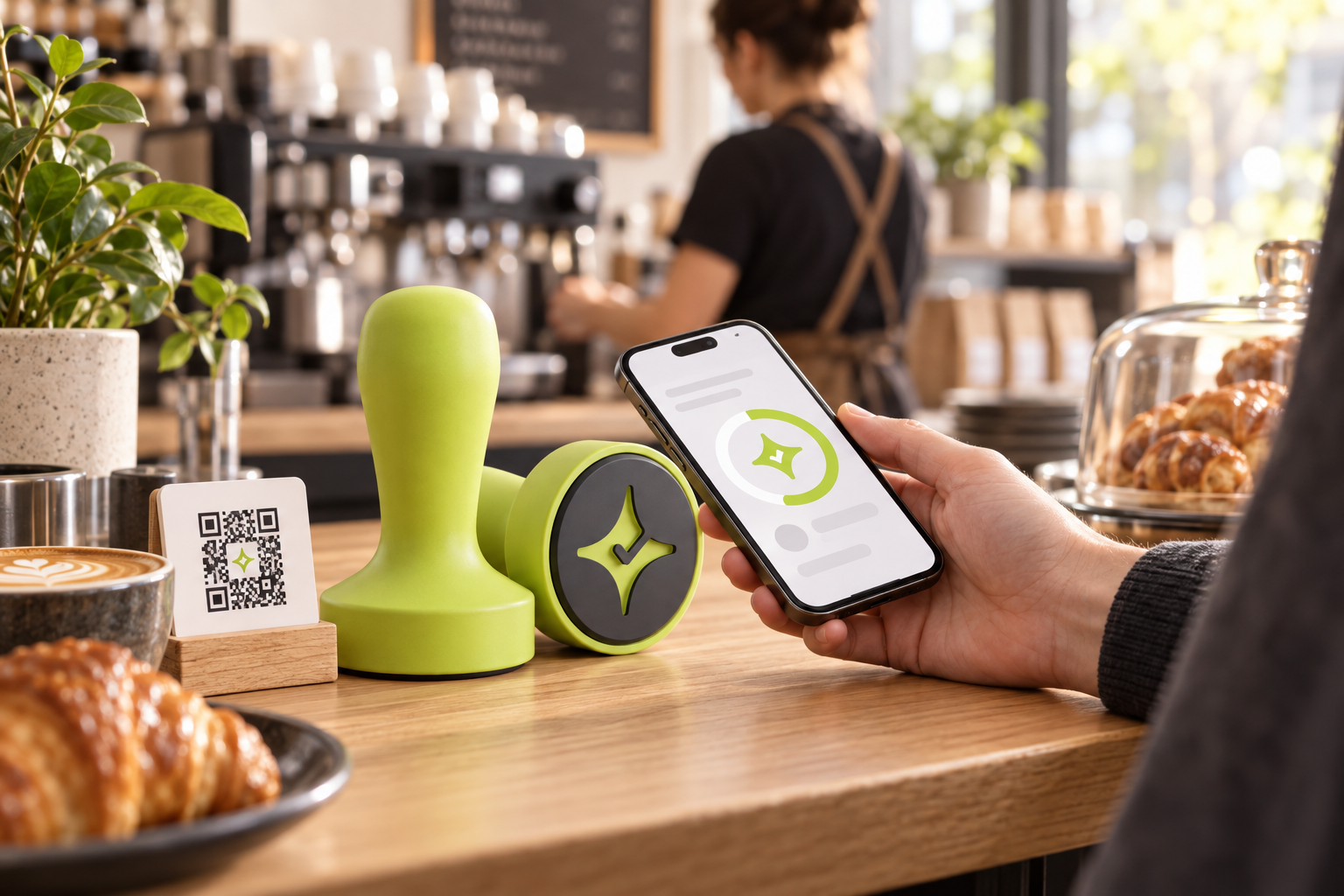

Çentik vs Voucherify at a glance
| Criterion | Çentik | Voucherify |
|---|---|---|
| Core product model | Ready-to-use digital loyalty for physical venues, centred on a browser card, NFC/QR earning, Wallet access and merchant tools. | API-first incentive and loyalty infrastructure for embedding into a larger stack. |
| Typical buyer | Independent cafés, hospitality venues and smaller repeat-visit businesses that want to launch without replacing their till. | Product, engineering, CRM and growth teams running more complex loyalty or promotion logic across digital and physical channels. |
| Customer-facing experience | Browser-based loyalty card; Apple Wallet and Google Wallet support are documented publicly. | Voucherify focuses on APIs/SDKs rather than a finished customer UI; its site says customers can build branded experiences and connect Wallet passes via APIs. |
| In-store interaction | First-party Çentik Stamp/NFC touchpoint plus QR. | POS-ready and channel-agnostic; the reviewed public material does not document a first-party countertop NFC device comparable to Çentik Stamp. |
| Loyalty depth | Public English pages emphasise stamp-based loyalty, reward tiers, customer profiles and repeat-visit campaigns. | Multi-currency wallets, tiers, pending periods, point expiration, household/team pooling, gamification and granular earning rules are documented. |
| Promotion breadth | Double-stamp, first-visit, win-back and birthday campaigns are publicly documented. | Coupons, cart promotions, loyalty, referrals, gift cards/store credit, bundling, gamification and stacking/exclusion logic are documented. |
| Integration model | Designed to run independently of the POS, reducing setup dependency on till integrations. | Designed to integrate into ecommerce, CRM, CDP, messaging and POS stacks via APIs, SDKs, webhooks and connectors. |
| Developer dependency | Low for the core in-store loyalty flow. | Meaningful engineering or implementation work is usually expected because Voucherify explicitly prioritises APIs/SDKs over out-of-the-box loyalty widgets. |
| Public trial | 30 days, no credit card stated on Çentik's English site. | 60 days with all campaign modules according to Voucherify's current pricing page. |
| Public pricing | Çentik's English pages are currently inconsistent: the homepage shows US$9.99/month while /en/pricing shows ₺999/month. | Voucherify currently lists Business at €600/$650 per month, Organization at €1,200/$1,300, and Enterprise as custom. API allowances shown on Voucherify's own pricing page differ from AWS Marketplace, so the contracted limits should be confirmed. |
| Security/compliance evidence | Çentik publishes an English privacy notice and describes consent-based marketing, but the reviewed public pages do not provide the same depth of enterprise security certification material seen on Voucherify. | Voucherify publicly states ISO 27001 certification, GDPR compliance, AWS-based infrastructure and enterprise governance options. |
Where Voucherify is materially stronger
Voucherify is the more capable choice when loyalty is only one part of a larger incentive architecture. Its current loyalty product supports multiple currencies within one programme, configurable tiers, pending points, different expiration models, household or team pooling, gamification and detailed earning controls. The wider platform also combines coupons, referrals, gift cards/store credit, cart promotions and stacking rules. Those capabilities matter for retailers, marketplaces, travel brands, fintechs or larger hospitality groups with several channels and complex commercial rules.
Its integration model is also much deeper. Voucherify publishes connectors and integration patterns across ecommerce, POS, CRM/CDP, messaging and automation tools, and it supports webhooks plus event streaming. This gives engineering teams more freedom to make loyalty logic part of an existing stack rather than adopt a finished front-end product.
Where Çentik is more direct for a physical venue
Çentik concentrates on the moment that matters in a café or other repeat-visit venue: the customer is standing at the counter and needs to earn progress with very little friction. The customer can use NFC or QR, the loyalty card opens in the browser, and the same card can live in Apple Wallet or Google Wallet. The venue does not need to replace its POS to start. That makes the implementation surface much smaller than a composable API platform.
Çentik also bundles venue-specific operating tools that are not the centre of Voucherify's proposition, including barista accounts, QR Menu Pro, repeat-visit analytics and simple reactivation campaigns. For a small operator, that packaging can be more useful than having a deeper rule engine that still needs a customer interface and integration work around it.
Important limitations and verification points
- Voucherify is not presented as a plug-and-play café loyalty app. Its own FAQ says it focuses on APIs and SDKs rather than out-of-the-box loyalty widgets, so implementation effort, front-end ownership and ongoing engineering capacity should be budgeted.
- Voucherify's current public pricing is enterprise-oriented compared with lightweight SMB loyalty tools. The live vendor page lists Business at €600/$650 per month and Organization at €1,200/$1,300 per month.
- Voucherify's live pricing page and AWS Marketplace currently disagree on included monthly API calls for the same named USD tiers. Do not base procurement on a directory screenshot; confirm the signed order form and applicable limits.
- Çentik's public English pricing is also inconsistent today: the homepage and /en/pricing page show different currencies and amounts. UK pricing should be normalised before this comparison page is published as a commercial landing page.
- Çentik's English homepage lists multi-location support, but the FAQ on the same page says multi-location management is still in progress. Treat multi-location as a feature to verify before contracting or publishing a definitive claim.
- Voucherify documents far more advanced loyalty rules and enterprise controls than Çentik's current public English pages. If a buyer needs multi-currency wallets, complex promotion stacking, large integration estates, private hosting or advanced governance, Çentik should not be positioned as feature-equivalent without additional product evidence.
Pricing and total implementation cost
A headline subscription comparison alone is misleading because the two products have different implementation models. Voucherify's Business plan is currently listed at €600 or $650 per month and Organization at €1,200 or $1,300, with Enterprise priced by quote. Pricing is primarily tied to API usage and project count. A 60-day trial is listed. Çentik offers a 30-day no-card trial, but its public English pricing needs reconciliation before a UK number is quoted: the homepage currently shows US$9.99/month while /en/pricing shows ₺999/month.
For a fair total-cost comparison, UK buyers should include implementation, front-end build, POS/ecommerce integration, data migration, support level and ongoing engineering—not only the software fee. Voucherify can justify a higher platform price when its rule engine replaces several separate promotion systems; Çentik can be economical when the requirement is a focused in-store loyalty programme that can launch largely as-is.
UK data protection and marketing compliance
Neither platform removes the merchant's responsibility under UK data protection and electronic marketing rules. The ICO says organisations sending electronic marketing normally need valid consent unless a specific exception applies, and they should keep records showing who consented, when and how. That makes consent provenance, suppression lists and channel preferences migration data—not optional marketing metadata.
Voucherify publicly states GDPR compliance and ISO 27001 certification and describes AWS-based security controls. Çentik's public privacy notice says marketing messages are sent where users consent and describes the categories of loyalty, account, business and technical data it processes. A UK buyer should still review the applicable DPA, subprocessors, international transfer safeguards, retention/deletion processes, breach procedures and role allocation for controller/processor responsibilities before go-live.
Migration considerations: Voucherify to Çentik
A migration should begin by separating data that maps cleanly from features that do not. Voucherify documents CSV-based migration workflows for loyalty cards, including initial point balances, and separate documentation covers customer import and programmable exports. When moving away, preserve stable customer identifiers, current balances, reward eligibility, expiry state, redemption history needed for service or audit, and marketing-consent evidence.
- Inventory the current Voucherify programme: currencies, tiers, earning rules, rewards, referrals, coupons, gift cards, segments, expirations and integrations.
- Decide what maps directly to Çentik's publicly documented model and what must be simplified, retired or kept in another system. Voucherify features such as multiple loyalty currencies, complex stacking, household/team pooling or advanced promotion rules may not have a documented one-to-one Çentik equivalent.
- Export customer identities and balances, then separately preserve consent evidence and suppression preferences. Do not convert an unknown marketing status into consent.
- Create a reconciliation file with old ID, new ID, opening balance or stamp count, reward state and migration timestamp. Test a representative sample before the full cutover.
- Run a short freeze window, reconcile totals, then communicate the change in plain language. Preserve enough historical data to resolve customer disputes after launch.
Çentik's public site says existing paper punch-card progress can be carried over by setting each customer's starting stamp count, but a public bulk enterprise migration specification is not exposed in the reviewed pages. For a Voucherify-scale migration, confirm import format, maximum batch size, identifiers, rollback procedure and support ownership directly with Çentik before committing.
Migration considerations: Çentik to Voucherify
Voucherify has explicit migration tooling for customers and loyalty cards. Its documentation says customers can be imported or updated by CSV, and loyalty-card imports can include an initial points balance for newly imported cards. The harder part is not the file format; it is redesigning the customer experience because Voucherify does not provide the same ready-made counter flow by default. A buyer would need to decide how the customer sees the programme, how POS events reach Voucherify and whether Apple/Google Wallet passes are built directly or through a wallet provider.
Who each option is best for
| Use case | Better fit | Why |
|---|---|---|
| Independent café or bakery wanting a digital stamp card quickly | Çentik | The product already centres on NFC/QR counter earning, browser access, Wallet cards, venue campaigns and barista workflows. |
| Small hospitality operator that does not want to replace or deeply integrate its POS | Çentik | The public product is designed to operate independently of the till. |
| Enterprise retailer or digital marketplace with complex promotion logic | Voucherify | Its documented rule engine spans loyalty, coupons, referrals, gift cards, cart promotions, stacking, multiple currencies and cross-channel APIs. |
| Product team that wants loyalty embedded in its own app, site and backend | Voucherify | Voucherify is explicitly API-first and expects brands to own the UI and integration layer. |
| Organisation needing documented enterprise governance, private hosting options or ISO 27001 evidence | Voucherify | These controls are publicly described on Voucherify's current pricing and security materials. |
| Venue prioritising a physical branded NFC touchpoint at the counter | Çentik | Çentik publicly documents its own NFC Stamp device plus QR as first-party earning methods. |
Decision checklist for a UK buyer
- Do you need a finished counter experience, or are you buying an incentive engine to embed in your own product?
- Will the programme use one simple loyalty currency, or several currencies, tiers, partner credits, referrals, gift cards and complex promotion rules?
- Who owns the customer interface and integration work: your team, an agency, or the vendor?
- Do you need to run independently of the POS, or must loyalty be transaction-native across ecommerce and in-store systems?
- What are your peak API volumes, and which limits apply in the signed Voucherify commercial terms?
- Which security certifications, hosting controls and contractual data-protection terms are mandatory for your organisation?
- Can your existing customer balances, reward states and marketing permissions be mapped without losing meaning?
Frequently asked questions
Is Çentik a direct replacement for Voucherify?
Sometimes, but not in every architecture. Çentik can replace the customer-facing loyalty layer for a physical venue when the programme is mainly about repeat visits, stamps, simple rewards and counter activation. It is not publicly documented as a like-for-like replacement for Voucherify's broader promotion engine, multi-currency logic, referral/gift-card stack or enterprise integration controls.
Does Voucherify support Apple Wallet and Google Wallet?
Yes. Voucherify documents Apple Wallet and Google Wallet pass scenarios, but its model is API-led: brands generate and update passes through integrations or external wallet services rather than receiving the same ready-made venue flow that Çentik markets.
Does Voucherify include a customer loyalty app or widget out of the box?
Voucherify's current loyalty FAQ says its focus is APIs and SDKs so brands can ship their own UI, with samples and partner accelerators available as starting points.
Can Voucherify loyalty data be migrated?
Voucherify documents CSV workflows for importing customers and loyalty cards, including initial loyalty points for new cards, and programmable export workflows for customer and loyalty-related data. This supports controlled migrations, but the destination still needs a clear mapping for balances, rewards and consent state.
Which platform is cheaper in the UK?
A reliable direct answer is not possible from the current public pages. Voucherify's live vendor pricing starts at €600/$650 per month for Business, while Çentik's English pages currently show conflicting public prices and currencies. Compare confirmed quotes plus implementation and integration cost, not only the subscription headline.
What should a UK business preserve when migrating loyalty customers?
At minimum: stable customer identifiers, current loyalty balances or stamp counts, reward eligibility, relevant redemption history, expiry state, and documented marketing preferences. ICO guidance says organisations should be able to show who consented to electronic marketing, when and how.
Bottom line
This is less a contest between two identical loyalty products than a choice between two architectures. Çentik is built around a ready-made in-store loyalty journey with a physical NFC/QR touchpoint, browser card and mobile-wallet access. Voucherify is a broader composable incentive engine with substantially deeper rules, APIs and enterprise integration options. The right shortlist depends on whether the primary problem is launching a friction-light loyalty experience at the counter or operating complex incentives across a larger technology stack.
See whether Çentik fits your in-store loyalty model
If your UK venue needs a simple NFC/QR loyalty flow without asking customers to install another app or replacing the till, review Çentik's current product and verify UK pricing, multi-location status and migration requirements before rollout.
Explore Çentik