
Quick answer: they solve different jobs
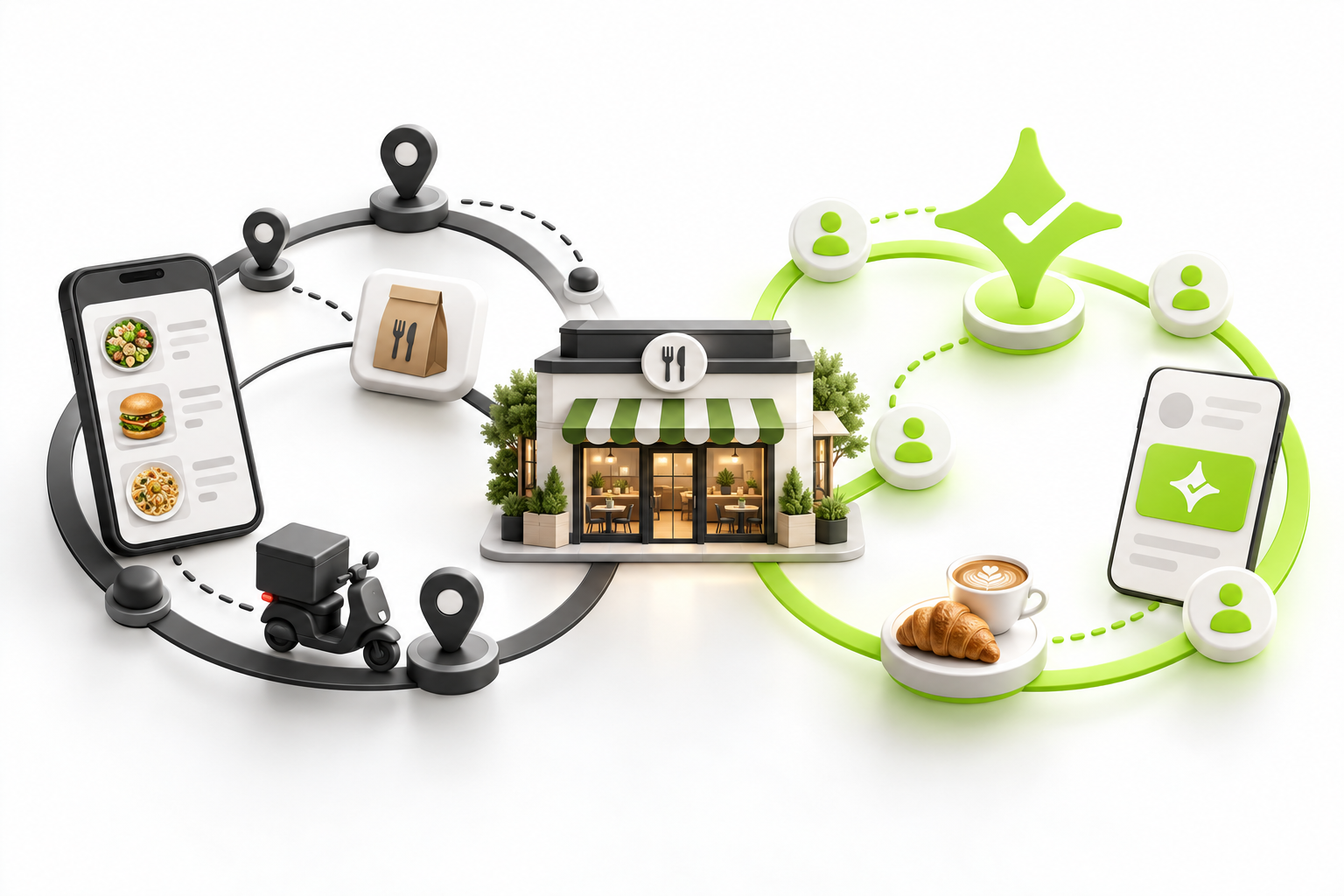
Uber Eats is built to help restaurants participate in a large delivery and pickup marketplace, manage orders, access courier fulfillment, run ads and offers, and analyze marketplace sales and customer behavior. Çentik is built around a different job: rewarding repeat in-person visits with a browser-based digital loyalty card that can be updated through NFC or QR, without requiring customers to install a dedicated Çentik app or the merchant to replace its POS. For many independent cafés and restaurants, this is therefore an acquisition-and-fulfillment versus in-store-retention comparison rather than a like-for-like loyalty software comparison.
| Criterion | Çentik | Uber Eats |
|---|---|---|
| Primary job | In-store loyalty and repeat-visit retention | Marketplace discovery, delivery, pickup and online ordering |
| Customer experience | Browser-based digital stamp card; NFC or QR; Apple Wallet and Google Wallet are promoted on Çentik’s English site | Customers order through the Uber Eats app or web marketplace; Uber One is Uber’s paid membership program with eligible order benefits |
| Delivery network | No delivery marketplace or courier network publicly offered | Courier delivery, merchant self-delivery, pickup, Uber Direct and Webshop options are publicly offered |
| Loyalty model | Merchant-configured digital stamp and reward program focused on repeat visits | Uber One is a platform membership; Uber Eats also provides merchant offers and customer-retention analytics, but this is not the same product model as an independent in-store NFC/QR stamp card |
| Merchant analytics | Repeat-visit, customer, reward and stamp analytics are promoted by Çentik | Sales, order volume, ticket size, new-versus-returning customer data, retention and operational analytics are available in Uber Eats Manager |
| POS dependency | Çentik states that core use can run independently of the merchant’s POS | Uber Eats can operate through its merchant tools and supports restaurant order-management workflows and integrations |
| Public U.S. pricing model | Subscription: Çentik Pro $19.99/month for the first location, $4.99/month per additional location, billed in US dollars; 30-day free trial, no card required (checked 28 September 2026) | U.S. marketplace delivery fees are listed at 20% Lite, 25% Plus and 30% Premium; Plus charges 30% on Uber One member orders. Pickup is 7% with validated in-store pricing, otherwise 10%. Self-delivery is listed at 15%. Webshop is listed at 2.5% + $0.29 per order, and Uber Direct starts at $7.99 per delivery. Terms and local exceptions apply. |
| Best fit | Businesses prioritizing owned in-store repeat visits and a lightweight loyalty layer | Restaurants prioritizing off-premise reach, delivery logistics, marketplace demand and order volume |
Where Uber Eats is stronger
Uber Eats has capabilities that Çentik does not try to replace: consumer marketplace demand, delivery logistics, pickup ordering, restaurant order management, advertising and offer tools, and access to Uber One members on eligible plans. Its U.S. merchant pricing page also distinguishes Marketplace, Self-delivery, Uber Direct and Webshop, making it useful for operators who need to acquire and fulfill off-premise orders rather than only increase repeat visits. Uber Eats Manager provides sales, order, item, operational and customer-retention analytics inside the Uber ecosystem.
Where Çentik is different
Çentik’s value proposition is narrower and more in-store: a customer can open a digital loyalty card in the browser, receive a stamp through the Çentik NFC counter touchpoint or QR flow, and track progress toward merchant-defined rewards. Çentik also promotes Apple Wallet and Google Wallet support, campaigns such as double-stamp, win-back and birthday offers, and repeat-visit analytics. Its public privacy policy says Çentik processes loyalty data on behalf of the café that owns the customer relationship. This makes Çentik more relevant when the core problem is recognizing and rewarding the customer who physically comes back, not delivering the next order.
Who each option is best for
Choose based on the job you need done. Uber Eats is the more relevant option when a restaurant needs marketplace reach, courier fulfillment, pickup ordering, paid in-app visibility or off-premise demand. Çentik is the more relevant option when an independent café, bakery or other repeat-visit venue wants a simple in-store loyalty layer without forcing a dedicated app download or a POS replacement. A restaurant that depends on both delivery demand and walk-in regulars may rationally use both rather than treat them as mutually exclusive.
Important limitations and verification points
- Çentik is not a delivery marketplace, courier network or online-order acquisition engine, so it does not replace Uber Eats when delivery reach is the objective.
- Uber Eats is not simply a café punch-card product. Its core economics, customer journey and merchant tools are centered on marketplace orders, fulfillment, advertising, offers and platform membership.
- Uber Eats marketplace fees can materially affect unit economics. Its U.S. pricing page currently lists 20%, 25% and 30% delivery marketplace tiers, with additional plan-specific terms, while independent restaurant trade publications reported the March 2026 fee changes and operator concerns.
- Çentik Pro is $19.99 a month for the first location and $4.99 a month for each additional location, billed in US dollars for businesses outside Türkiye, with a 30-day free trial and no credit card required. (Checked against Çentik’s billing catalogue and centik.app/en/pricing on 28 September 2026.)
- Multi-location use is available today: additional locations run from the same Çentik account, each billed at $4.99 a month.
- Public Uber Eats documentation confirms aggregated customer and retention insights plus downloadable financial and operational reports, but it does not clearly document a self-service export of individual marketplace customer identities for use in another CRM. Do not assume such identities can be migrated.
Can Çentik and Uber Eats work together?
Yes, because the products can sit at different points in the customer journey. Uber Eats can serve delivery and pickup demand, while Çentik can serve the loyalty experience for customers who interact directly with the venue in person. The operational rule is to keep the data boundaries clear: use Çentik to collect and manage loyalty relationships through lawful direct interactions, and do not assume that marketplace customer records from Uber Eats may be exported or repurposed outside the platform. This combined approach is a channel strategy, not a data-transfer shortcut.
Migration and rollout considerations
Moving from Uber Eats to Çentik is usually not a conventional software migration because the systems represent different channels. If the goal is to reduce dependence on marketplace orders while building more repeat in-store business, start by defining the in-store reward economics, placing the NFC/QR touchpoint at the counter, training staff on the stamp flow and measuring repeat visits over several weeks. Import only customer data that you lawfully control and can export. If delivery remains profitable, keeping Uber Eats active while adding Çentik may be more practical than switching it off. Conversely, moving from Çentik to Uber Eats requires a marketplace setup: menu or catalog configuration, fulfillment choices, pricing-tier review and a margin model that includes per-order marketplace costs.
Decision criteria for U.S. operators
Use five questions to make the decision: Is the priority delivery acquisition or in-store retention? Do you need courier fulfillment? Do you want loyalty to work without a dedicated customer app? Can your margins support percentage-based marketplace fees on delivery orders? And do you need identifiable first-party loyalty profiles, or are platform-level new-versus-returning insights sufficient? Answering those questions usually makes the category difference clearer than comparing feature counts.
Are Çentik and Uber Eats direct competitors?
Not in the usual software-category sense. Uber Eats is primarily a delivery and ordering marketplace; Çentik is an in-store loyalty and repeat-visit platform. They compete only when a merchant is deciding where to spend a limited growth budget.
Can Uber Eats replace an in-store loyalty program?
Uber Eats provides Uber One benefits, offers and customer-retention analytics, with loyalty-related capabilities also appearing in its merchant ecosystem. Those tools remain embedded in the Uber Eats marketplace model. A merchant seeking a dedicated NFC/QR stamp card for walk-in visits is solving a different problem.
Can a restaurant use Çentik and Uber Eats together?
Yes. A restaurant can use Uber Eats for delivery and marketplace demand while using Çentik for direct in-store loyalty. Keep customer-data collection and permissions separate and do not assume marketplace customer identities can be exported.
Which has the lower cost?
There is no fair single-number answer because the pricing models are different. Uber Eats publicly lists percentage-based marketplace fees and per-order or direct-order products. Çentik uses a flat subscription: Çentik Pro is $19.99 a month for the first location and $4.99 a month for each additional location, billed in US dollars, with a 30-day free trial (checked 28 September 2026).
Can I migrate my Uber Eats customer list into Çentik?
Do not assume so. Uber’s public merchant documentation describes customer insights and downloadable financial and operational reports, but does not clearly document a self-service export of individual marketplace customer identities for external CRM use. Verify your contractual rights and available exports before planning a migration.
Build the in-store loyalty layer separately from delivery
If your goal is to reward repeat in-person visits without replacing your POS or requiring customers to download a dedicated app, start with Çentik’s 30-day trial. If marketplace reach and courier fulfillment are the priority, evaluate Uber Eats on its own economics and keep the two decisions separate.
Start Çentik free trial